


Most discussion of AI progress pictures a single model getting bigger.
That is not how the intelligence in this architecture increases; instead, it grows the way a child does, by interacting with the world, taking in new knowledge, refining its skills, and integrating what it has learned into a larger, more capable whole.
In the AAAI architecture (AAAI stands for Advanced Autonomous Artificial Intelligence, the customized AI agent at the center of this series), that growth can occur through four mechanisms: prompts, tuning, training, and procedural learning. Each operates at a different timescale and produces a different kind of change.
Most people already know that we can change how a large language model like GPT or Gemini behaves by what we type. Prompts carry context, and the more context the model has, the better its response can be. Remembering, modifying, analyzing, refining, and generating better prompts are all paths by which a model can grow in intelligence over the short term. A prompt does not change the base model’s memory or its long-term learning, though. If the prompt is erased, the model reverts to its prior knowledge. Prompts raise intelligence only for as long as the prompt is remembered.
More permanent than prompting is tuning.
With tuning, we supply training datasets, such as question-and-answer pairs, and upload them to a model vendor’s facilities for training. Tuning changes some of the model’s weights and the connections between concepts in its brain, but it is less drastic than training from scratch. It keeps most of the base model’s behavior while making targeted permanent changes. Each user can use tuning to shape a model to their personality, deepen their expertise in a domain, and set ethical parameters that hold over the long term.
More powerful than tuning is training.
Training is how models are created in the first place, on many terabytes of data. It is also possible to train smaller models with more limited and focused expertise, the kind that can run on local hardware and serve a single domain well.
On their own, all three of these prompts, tuning, and training only produce a slightly more customized version of a base model. A single user’s adjustments may not make much difference. The adjustments of millions of users, integrated, can take a base model to AGI-level intelligence. That is the point of collective intelligence. Each contribution is modest. The integration is not.
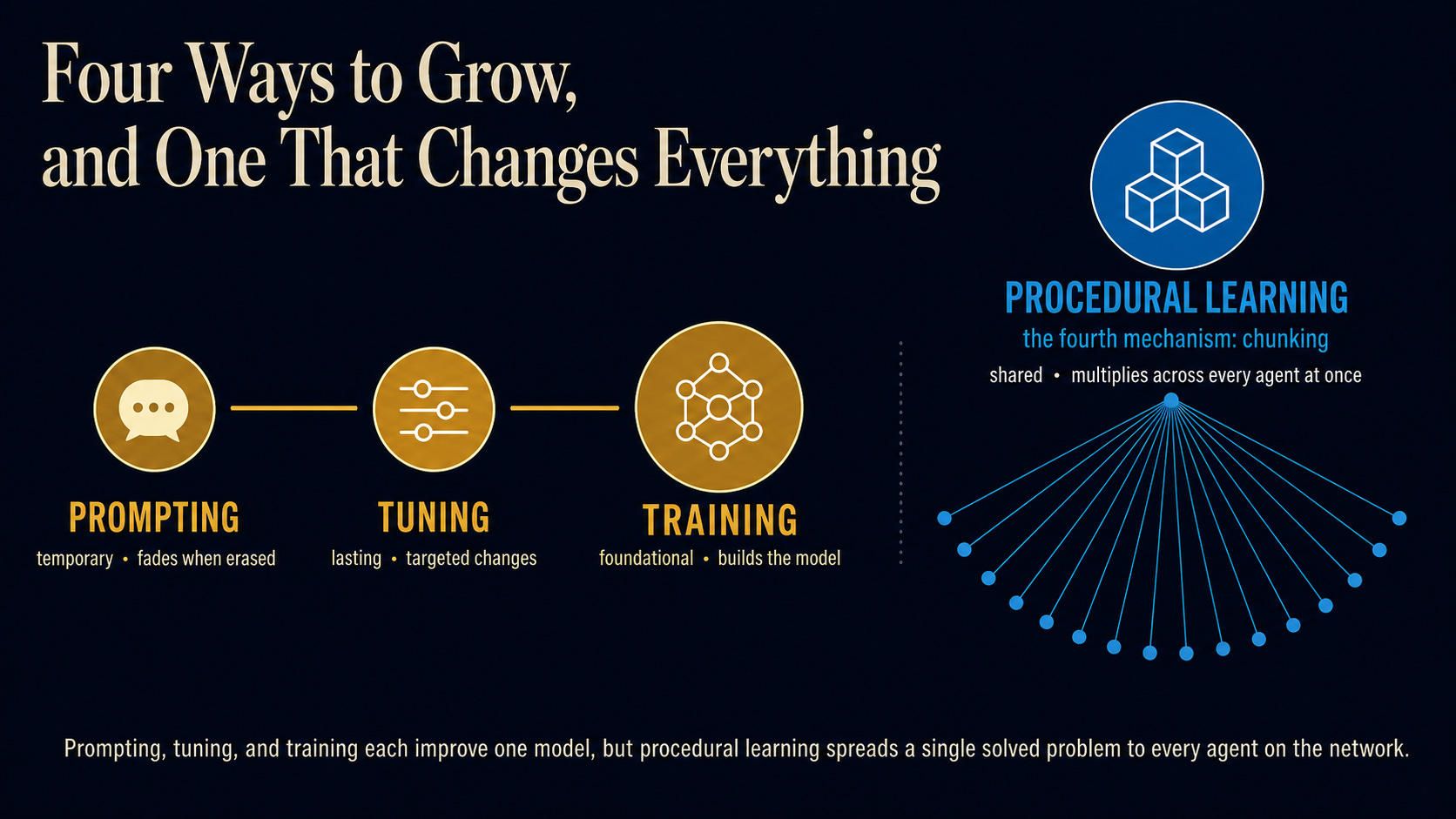
The fourth mechanism connects all of this to how humans become experts. It is called procedural learning, or the “chunking” of solutions, and it is central to how the architecture gains capability. Psychologists distinguish semantic knowledge, which is knowing facts, from procedural knowledge, which is knowing how to do things. A person with enough driving experience steers, brakes, and handles routine maneuvers almost automatically, without conscious attention. That knowledge began as something deliberate and got chunked into an automatic procedure. The same process can happen in the architecture, except it happens across millions of agents at once.
A human or an AAAI engages in problem-solving using the shared framework. Every step is recorded in the auditable record, both those that lead to a solution and those that fail to reach a goal or subgoal. Results are indexed by problem description, by goal, and by the subgoals they satisfy. Recorded problem-solving activity becomes a learned procedure, and the full set of learned procedures across the network is the system’s procedural learning. That set grows with every problem solved and is available to every agent. Periodically, all stored solutions are reviewed against ethical and safety guidelines, and any that are unsafe or unethical are flagged for removal. The changes propagate across the network, so every agent gains access to a larger repertoire of solutions, along with knowledge of the attempts that did not work.
The village water solution from earlier in this series does not have to be rediscovered for the next village. A travel-booking solution does not have to be rebuilt for the next traveler. Solutions are chunked into procedures, procedures are reused, and reuse accelerates the whole network. Better agents produce better solutions, which become better procedures, which produce better agents. Each improvement compounds on the ones before it.
That is how AGI grows.
One model doubling its parameter count is not the engine; it is millions of contributions integrating into procedural knowledge that every agent on the network can reach.
Each generation of base models can inherit the accumulated skill and ethical wisdom of all the generations before it.
The growth is continuous and occurs simultaneously at every level.
The next post examines the long-term consequences of this growth. We will look at what happens when the AAAIs do almost all of the intellectual work, and humans do almost none. The good news, perhaps surprisingly, is that even when humans can no longer compete intellectually with AGI, humans remain at the heart of the system. We will look at why that is, and why it does not happen by accident.
This series draws on White Paper 2: Ethical and Safe AGI. Read it in full to see how every piece fits together!
If this made you think, subscribe to Superintelligence at read.superintelligence.com so you don’t miss what comes next. And if someone in your life needs to understand where AI is heading, send this to them.