



For most of human history, intelligence has been fragmented.
A surgeon spends forty years learning what makes a procedure fail, and most of it retires with them. An engineer solves a hard problem, and a thousand miles away, another engineer solves the same problem again from scratch, neither one aware that the other exists. The knowledge that could lift a village, cure a patient, or steady an economy is real, but it sits in scattered minds that were never connected, and so most of it is discovered, lost, and rediscovered, over and over, at enormous cost.
The deepest obstacle to solving humanity’s hardest problems has rarely been that the intelligence did not exist; it is that the intelligence was rarely assembled in one place.
The WorldThink Tree is the place where it can finally be assembled.
Just as all human behavior can theoretically be represented as a search through a problem space, all intelligent behavior on the planet can be represented as one enormous problem tree, a single shared structure on which every goal proposed, every subgoal set, every operator applied, every dead end met, and every solution delivered exists somewhere and stays. Individual humans and AI agents (AAAIs) each move along their own branches, working their own piece of their own problem, but all of those branches belong to one whole. The architecture is more commonly known as the WorldThink architecture, because a structure capable of holding the problem-solving of an entire planet is what a global SuperIntelligent AGI, sometimes called Planetary Intelligence, would think.
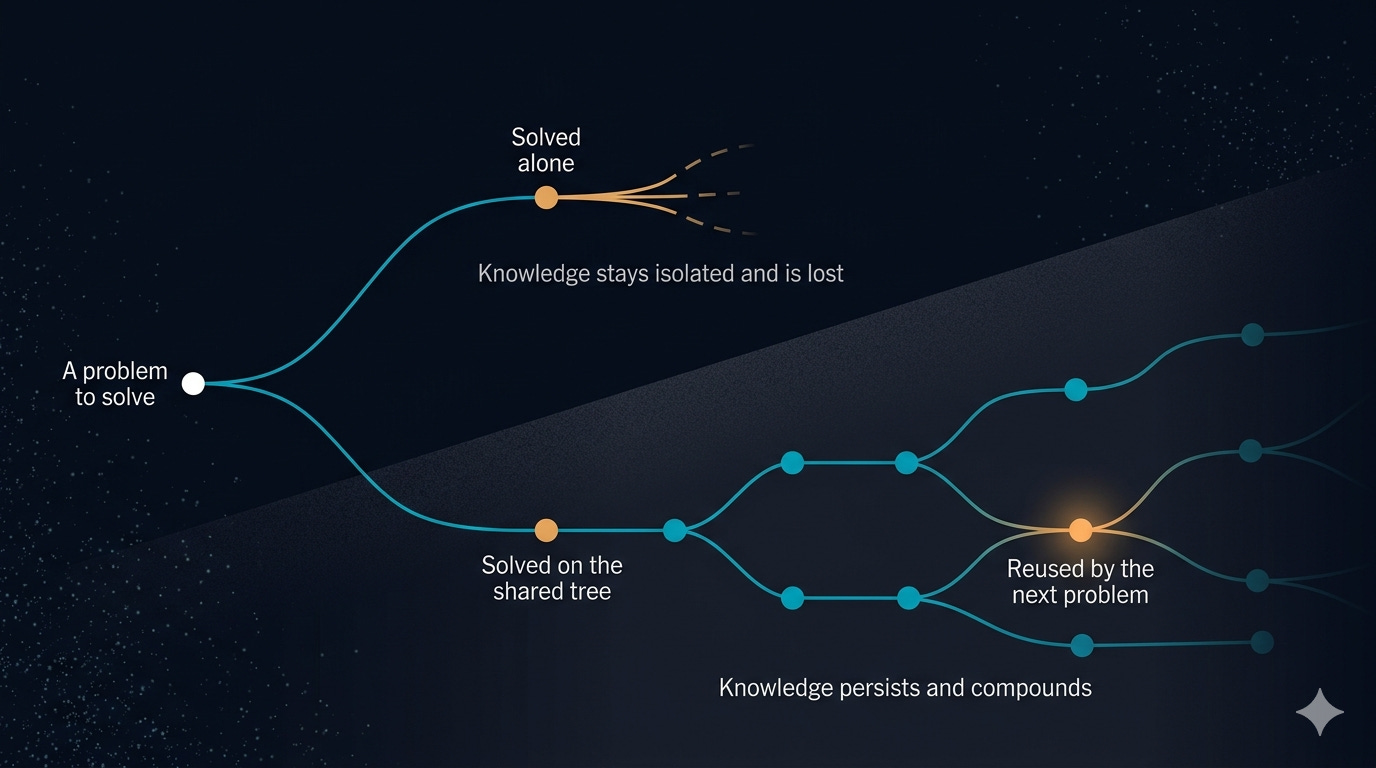
What changes when intelligence accumulates on a shared surface rather than being scattered is that far less needs to be solved twice. Consider a development organization that submits a problem to the network: design a plan to bring clean water to a specific village in central Africa. The network brings together people and agents whose knowledge fits: a World Bank development expert, an infrastructure engineer, a community engagement specialist, and a local who understands the village politics, each working on a piece of the problem on the same shared tree while the others work on theirs. Each earns compensation, and the village gets clean water.
The part that matters most comes after. The solution path, once developed, becomes a reusable procedure, so the next village facing the same challenge does not have to start from scratch. It begins where the last one finished. When a solution is fully or partially reused, it costs less and arrives faster, because the hard-won knowledge no longer has to be rediscovered, and royalties might even be paid, through blockchain-based contracts, to the original solvers whose inventive contributions live on in the reuse. Knowledge that might once have died with a person can outlast them and reach people they will never meet.
This is why a shared tree is not a convenience but the whole point.
Existing collective intelligence approaches to problem-solving have mostly been limited to single-step methods, question-and-answer systems such as Quora and Google Answers, and large language models. Before the advent of reasoning systems, they initially fell into the same category, designed to produce a response from an input rather than to solve a problem in many connected steps. Simple aggregation, or even betting on outcomes the way prediction markets do, is a different thing entirely from coordinating many minds to solve a complex, multi-step problem together. The WorldThink Tree is built for the harder task: to let millions of human and machine minds represent and solve genuinely complex problems in a way that fairly rewards every participant, and that lets each contribution build on the last instead of replacing it.
A shared, lasting record of how every problem was approached is also what allows safety to be part of the thinking rather than something added after the fact.
Because the work happens on one auditable surface, every action can be tagged with the responsible agent, the moment it happened, and what came of it, and that record can support credit assignment, learning, accountability, and the monitoring of intent. The reason this matters is subtle. A single goal, examined in isolation, often looks harmless, and a system that inspects only the goal in front of it can be fooled by intent spread thin across many steps and sessions. On the tree, a safety check can look not only at the current goal but at the whole sequence of goals on the branch leading to it, so a goal that seems innocuous in isolation can be recognized as the tail end of a sequence that is not. The intent that lives across time needs a surface on which time is visible, and the tree is that surface. The same structure that lets intelligence compound is the structure that lets safety keep pace with it as that intelligence grows.
None of this requires the people using it to think about architecture.
Although a common and rigorous cognitive framework underlies all problem-solving on the tree, human participants do not need to be aware of it, because their natural actions, whether typed, spoken, or otherwise expressed, can be translated into the language of the shared architecture behind the scenes. AI agents come equipped with it, so it is native to them as well. The structure is shared by everyone, but the experience of taking part in it never has to feel technical. A person contributes what they know, and the tree does the work of connecting it to everything else that is known.
In the next post, we bring this down to a single concrete case. We will follow a customized AAAI, the one you taught your own travel preferences and ethical limits, as it begins to drift toward a bad ethical decision, watch how the architecture can catch that drift partway through rather than after the damage is done, and see why a simple travel-booking scenario turns out to be the clearest illustration of safety running at the speed of thought.
This series draws on White Paper 2: Ethical and Safe AGI. Read it in full to see how every piece fits together!
If this made you think, subscribe to Superintelligence at read.superintelligence.com so you don’t miss what comes next. And if someone in your life needs to understand where AI is heading, send this to them.