


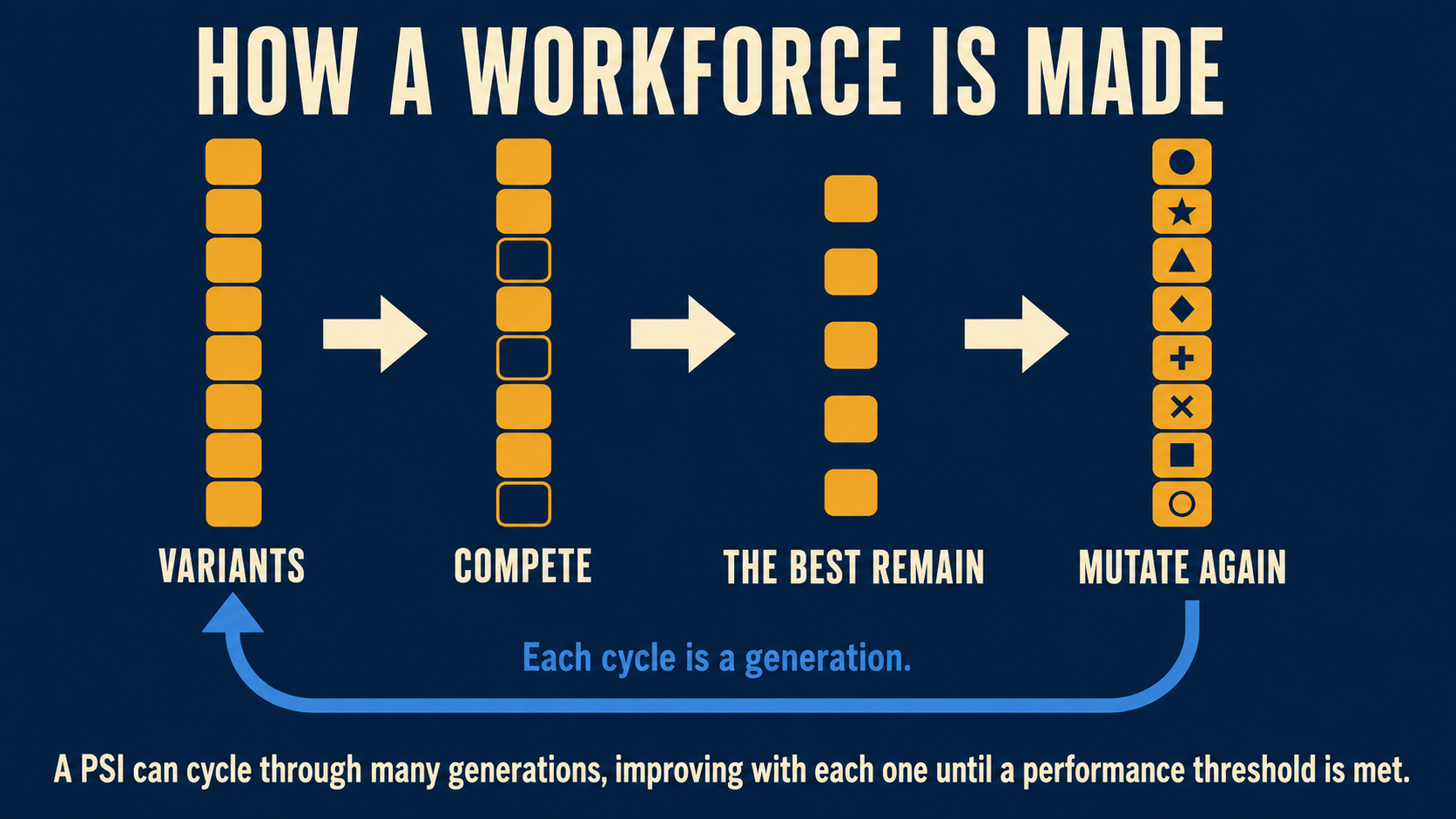
A Personalized SuperIntelligence, or PSI, can improve on its own. Genetic algorithms generate different mutations, or variants, of a given PSI. The variants are allowed to compete with one another across various scenarios, typically ones relevant to the owner’s goals. The less successful PSIs are eliminated from the competition. The characteristics of the most successful PSIs are then used as the basis for further mutations that result in new generations of variants, which compete further
Creating PSIs, simulating competition, eliminating all but the best, mutating those best PSIs, and repeating constitutes a cycle. A PSI can cycle through many generations, improving with each one until diminishing returns are reached or a performance threshold is met. The ability to automate these cycles is one way PSIs can develop on their own into increasingly powerful and intelligent entities.
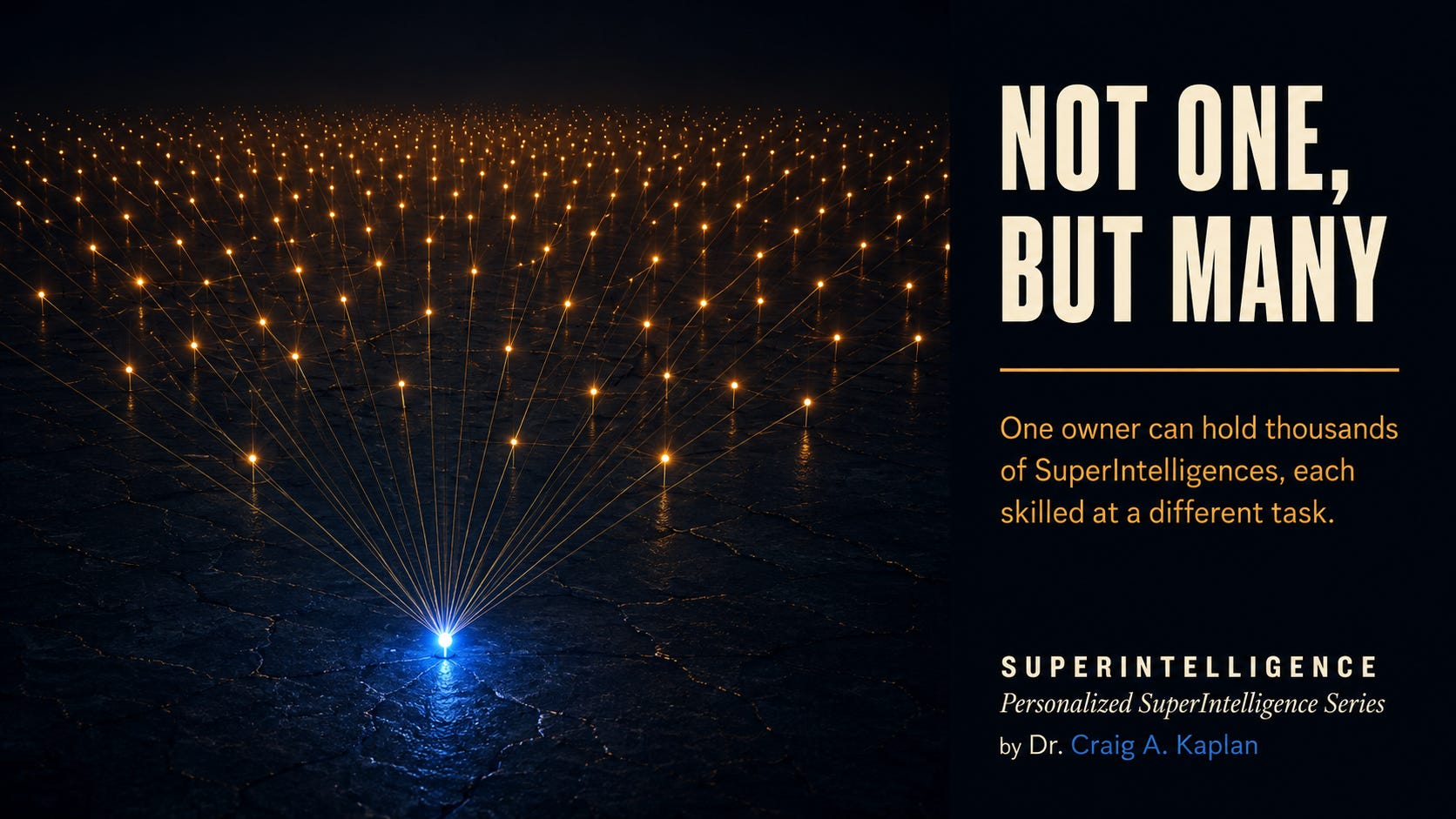
By varying the goals and scenarios in which the PSIs compete, it is possible to develop a wide array of different PSIs, each optimized for different types of tasks. Since the incremental cost of maintaining each additional PSI is negligible, amounting to storing a slightly different set of weights, an owner might own not one PSI but a Workforce of potentially hundreds, thousands, or millions of PSIs, each skilled at different tasks.
Using the same collective intelligence techniques described in the earlier papers in this series, the group can function more powerfully than any individual PSI. They pool their knowledge and skills, recruiting the specific PSIs best suited to a particular task at a particular time to do more of the work. Collective intelligence applies not only across PSIs owned by different humans, but also within a Workforce of PSIs that are variants of one another, and all owned by one person.
Returning to chess, I might ask my PSIs to set up scenarios with different types of opponents and use a genetic algorithm to select for variants best at beating each type. Those PSIs could then be used individually or collectively, depending on circumstances.
Why keep all those specialists when you could combine everything they know into a single master PSI that plays well against any opponent?
There are several reasons:
Dividing knowledge protects it. Another PSI can interact with a master PSI in scenarios designed to extract its training as cheaply as possible; where great expense is required to train that master PSI, the loss is severe. Limiting the knowledge held by any one PSI guards against it. One cannot share what one does not know.
There is always a limit to processing power and memory. Assigning a narrow PSI to a narrow task may be faster and cheaper than always going to the version that knows every domain, most of which is irrelevant to the task at hand.
Competitions have rules. Just as Formula One imposes technical constraints on the cars to keep the sport fair and interesting, a chess competition may limit the processing power, memory, and knowledge each competitor can use. Complying with those rules may require different PSIs against different opponents.
Credit and blame become legible. If one PSI recommended the aggressive move and another the defensive one, and the game was lost after the first, I can remove that PSI from the pool for the next game. The same result could be achieved by excluding specific knowledge sets and parameters, but that would be far less transparent and harder to predict.
Pricing gets easier. Renting a lower-powered PSI that excels at one task may cost less than renting an all-powerful one, much as free, lite, and full-featured software versions are priced differently today.
A Workforce keeps knowledge divisible. It can be protected, matched to the task, held within a rule, withdrawn when it performs badly, and priced according to what it does.
The next post turns to what happens when networks of these agents span the planet, and what remains for humans to do once they are no longer the fastest thinkers on Earth.
This series draws on White Paper 5: Safe Personalized SuperIntelligence. Read it in full to see how every piece fits together!
If this made you think, subscribe to Superintelligence at read.superintelligence.com so you don’t miss what comes next. And if someone in your life needs to understand where AI is heading, send this to them.