



Once a Personalized SuperIntelligence, or PSI, carries your knowledge and your ethics, it holds something other people want.
Peter is an expert chess player who particularly excels at openings. He has trained his own agent to play in his style, using data he carefully curated, and he offers to share both the weights his agent uses and the datasets behind them. I take him up on both.
First, I try Peter’s weights, attempting to combine them directly with my agent’s weights. They do not produce the desired outcome. So I try using subsets of the chess training data Peter curated to train my agent instead, and I find that this gives better results. Encouraged, I look online for additional chess training datasets available for purchase, locate several, and buy them.
The exchange runs in both directions. I have unique information on model rocket designs I have been experimenting with that is not widely known or available online, so I have decided to sell these specialized datasets to generate revenue. I have my AI export them, along with the weights from my training, in a format that can be shared with other owners. I also joined an exchange where I earn credits for various datasets and weight subsets, which I can then use to acquire datasets and weight subsets from other owners.
I can monetize both my knowledge, reflected in unique datasets I alone possess, and my effort, turning that knowledge into useful subsets of weights that enable my agent to behave in ways other agents cannot.
Having set the parameters, I step away while my AI operates autonomously until it encounters circumstances that require my involvement or notification. To minimize interruptions, I enable the agent to monitor its own behavior and working conditions, so that it can monitor its own ethical behavior, notice when costs are getting out of hand, recognize signs of an untrustworthy client, and detect when the environment in which it is working changes.
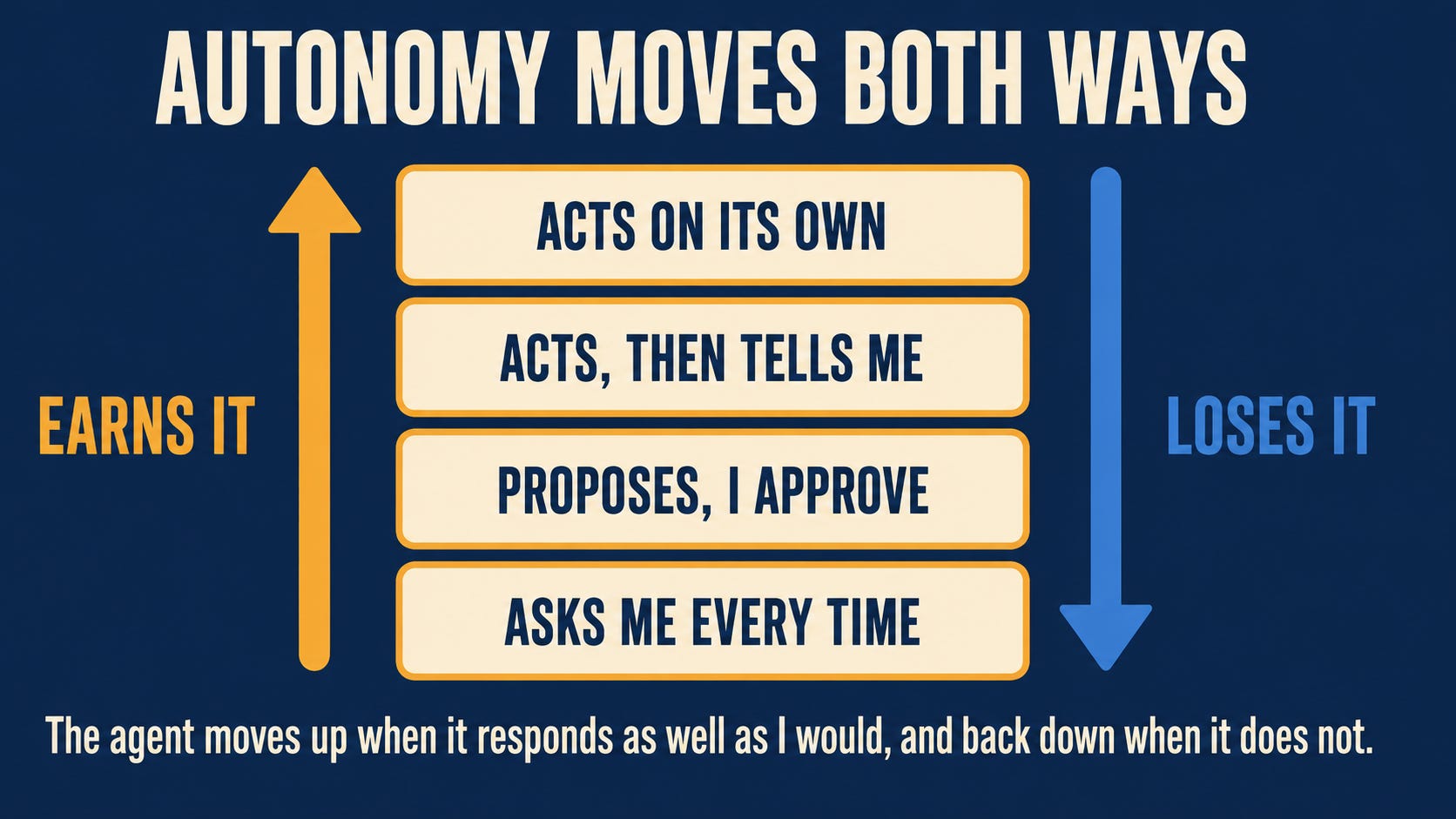
Each time the agent alerts me and requests intervention because of a knowledge gap, an ethical conflict, or another situation it feels ill-equipped to handle, it records how I respond, and it learns. The next time a similar situation occurs, it formulates a hypothetical response. Depending on the level of control I have specified, the agent either implements that response autonomously or proposes it to me and waits for my approval.
When I feel that the agent is responding as well or better than I could to certain types of situations, I may authorize it to respond directly to those situations without checking with me first. If it responds inappropriately, either I or an automated algorithm based on threshold parameters can require the agent to reduce its autonomy in those situations until it learns to respond better.
Much like a parent gradually gives more autonomy and responsibility to a child as the child learns, and reins the child in when the child makes mistakes or abuses the delegated responsibility, an owner can interactively provide more or less autonomy to AI agents.
Suppose I want to take a vacation and go offline for an extended period. My customized AI can still stay online, working and earning money for me in autonomous mode. Before leaving, I set certain parameters and guidelines, including but not limited to the type of engagements; payment rates; computing power used by the AI for any engagement; ethical boundaries and rules (which, if touched, trigger alerts and possible intervention by me); and quality, schedule, and cost triggers for alerting me or halting work until I approve.
Having set the parameters, I step away while my AI operates autonomously until it encounters circumstances that require my involvement or notification. To minimize interruptions, I enable the agent to monitor its own behavior and working conditions, so that it can monitor its own ethical behavior, notice when costs are getting out of hand, recognize signs of an untrustworthy client, and detect when the environment in which it is working changes.
Each time the agent alerts me and requests intervention because of a knowledge gap, an ethical conflict, or another situation it feels ill-equipped to handle, it records my response and learns. The next time a similar situation occurs, it formulates a hypothetical response. Depending on the level of control I have specified, the agent either implements that response autonomously or proposes it to me and waits for my approval.
When I feel that the agent is responding as well or better than I could to certain types of situations, I may authorize it to respond directly to those situations without checking with me first. If it responds inappropriately, either I or an automated algorithm based on threshold parameters can require the agent to reduce its autonomy in those situations until it learns to respond better.
Much like a parent gradually gives more autonomy and responsibility to a child as the child learns, and reins the child in when the child makes mistakes or abuses the delegated responsibility, an owner can interactively provide more or less autonomy to AI agents.
The next post turns to why you might want more than one of these agents, and why many specialized versions may better serve an owner than a single one that knows everything.
This series draws on White Paper 5: Safe Personalized SuperIntelligence. Read it in full to see how every piece fits together!
If this made you think, subscribe to Superintelligence at read.superintelligence.com so you don’t miss what comes next. And if someone in your life needs to understand where AI is heading, send this to them.