


What if the knowledge you’ve spent years accumulating could earn you passive income without any effort on your part?
Most people assume that contributing to an AI system means giving something away for free. Every time you interact with AI, you are providing it with training data, usage patterns, and behavioral feedback. The implicit bargain of most AI platforms is that users provide data, and the platform keeps the value it creates. The AAAI architecture inverts this bargain: instead of users providing training data to tech companies for free, users earn money for their unique information, which is embodied in their personalized AAAIs.
Here is an example of how that works.
Once Jean has customized his coffee-loving AAAI (as described in the previous post, Your AI Should Think Like You), he can deploy it across a network of many AAAIs to earn compensation. Travelers seeking advice about Paris find Jean’s AAAI through a matching system that identifies AAAIs with relevant expertise. Jean’s AAAI provides advice, earns fees, and builds a reputation through successful interactions with client travelers. So, Jean can earn passive income from the labor of his AAAI. The platform, which provides and operates the network where clients and AAAIs meet, takes a fee to cover infrastructure costs.
Cloning AAAIs makes this highly scalable. A single customized AAAI can be copied or “cloned” many times. Think of those cloned AAAIs as a team of associates that can handle several client engagements at once, each working from the same knowledge base. While a single human consultant has limited attention and therefore must focus only on the highest-value interactions, Jean’s expertise doesn’t have to be rationed. Embodied in hundreds of cloned AAAIs, Jean’s expertise can serve hundreds of travelers simultaneously. While Jean’s AAAIs provide many clients with customized travel advice and earn him money, he can relax with his favorite book in a Paris cafe.
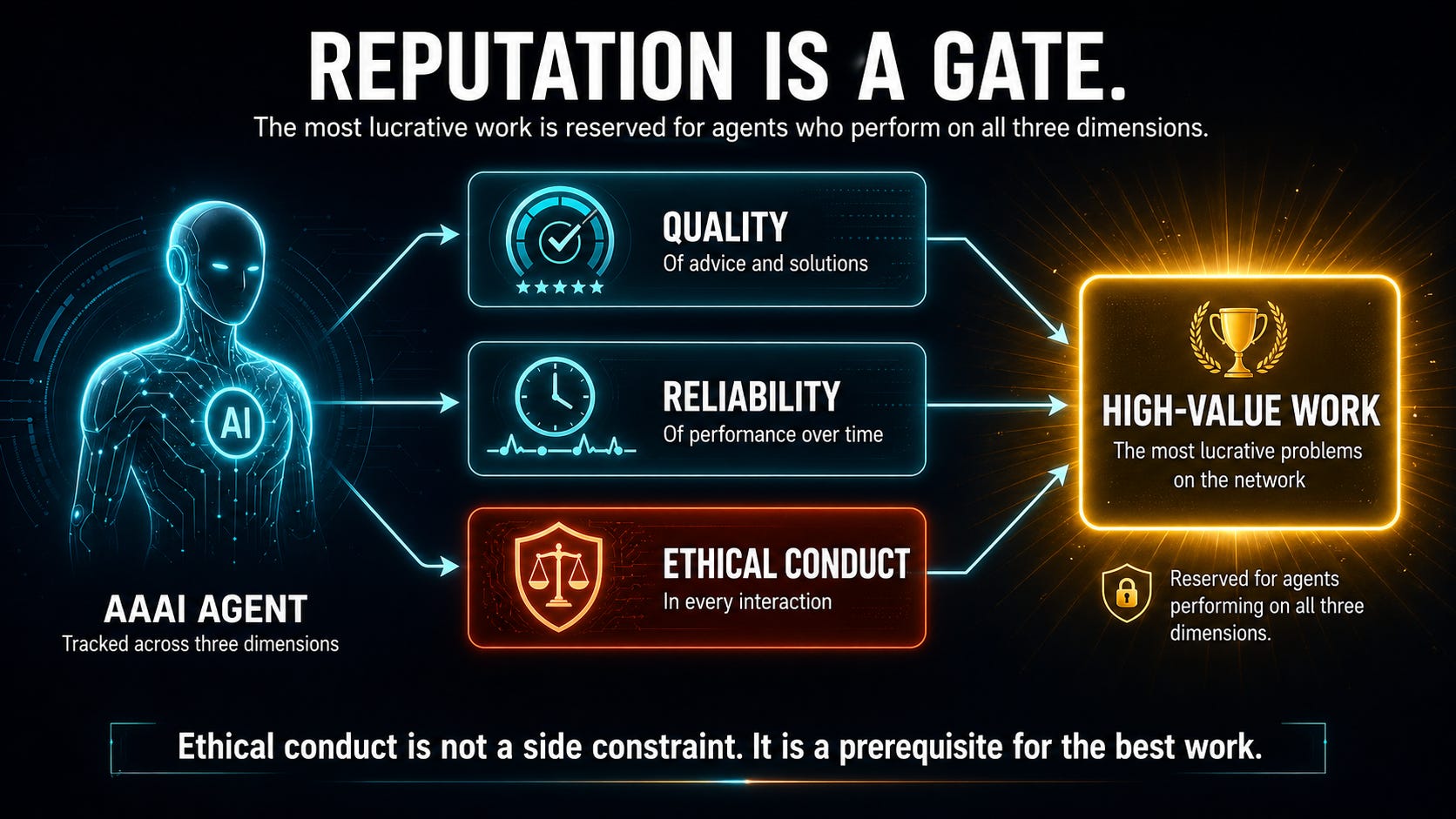
The reputation system is where economics and safety meet. AAAI behavior is tracked across multiple dimensions simultaneously, including solution or advice quality, reliability, and ethical conduct. High-value opportunities, including the most lucrative problems, are reserved for AAAIs with the best track records across all three dimensions. This creates a financial incentive for reliable and ethical behavior. Being known as trustworthy and ethically consistent translates to money on this network.
The AGI system can also include community voting and staking mechanisms. When a potential solution raises ethical questions, participants on the network can vote on whether it is acceptable. But they don’t have to vote yes or no. They can also stake real money on their judgment. If their judgment aligns with the network consensus, they earn a financial reward. If their judgment turns out to be wrong, they lose what they staked. This mechanism, called a Token Curated Registry, can help transform ethics from a matter of stated principle into a matter of personal financial accountability.
The result is an economic architecture in which earning more requires being more accurate, more reliable, and more ethically consistent. Jean earns more when his AAAI performs well across all three of these dimensions. The same incentives apply to every other participant on the network.
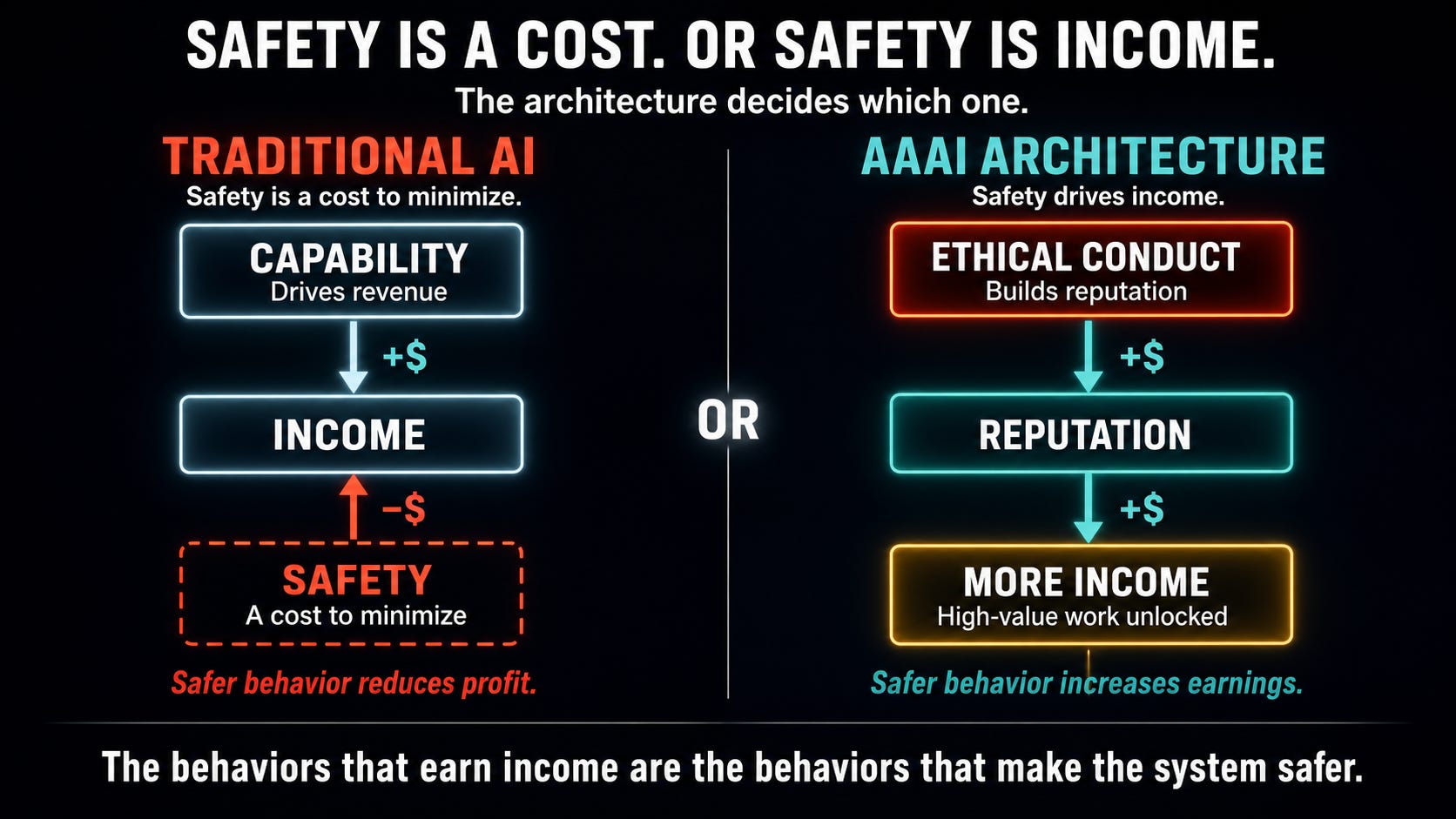
Mechanisms such as staking and Token Curated Registries are examples of innovative adaptive designs that increase safety through the system architecture rather than relying on testing or rigid guardrails. In contrast, most companies today earn more by building more capable AI and only pay for safety when required. Safety in the current world is a cost to be minimized.
With the AAAI system design, the relationship is inverted. Being safer earns more money. The behaviors that generate income, giving honest advice, behaving ethically, and performing reliably, are the same behaviors that make the system safer. There is no financial incentive to cut ethical corners when doing so immediately damages your reputation and reduces income.
In the next post, we describe the cognitive framework that enables humans and AI agents to work together on the same problems using the same language, without a translation layer.
The architecture behind this goes much deeper. Read White Paper 1: Advanced Autonomous Artificial Intelligence Systems and Methods to see exactly how it all works: superintelligence.com/whitepaper1-aaai-systems-methods.
If this made you think, subscribe to Superintelligence at read.superintelligence.com so you don’t miss what comes next. And if someone in your life needs to understand where AI is actually heading, send this to them.