


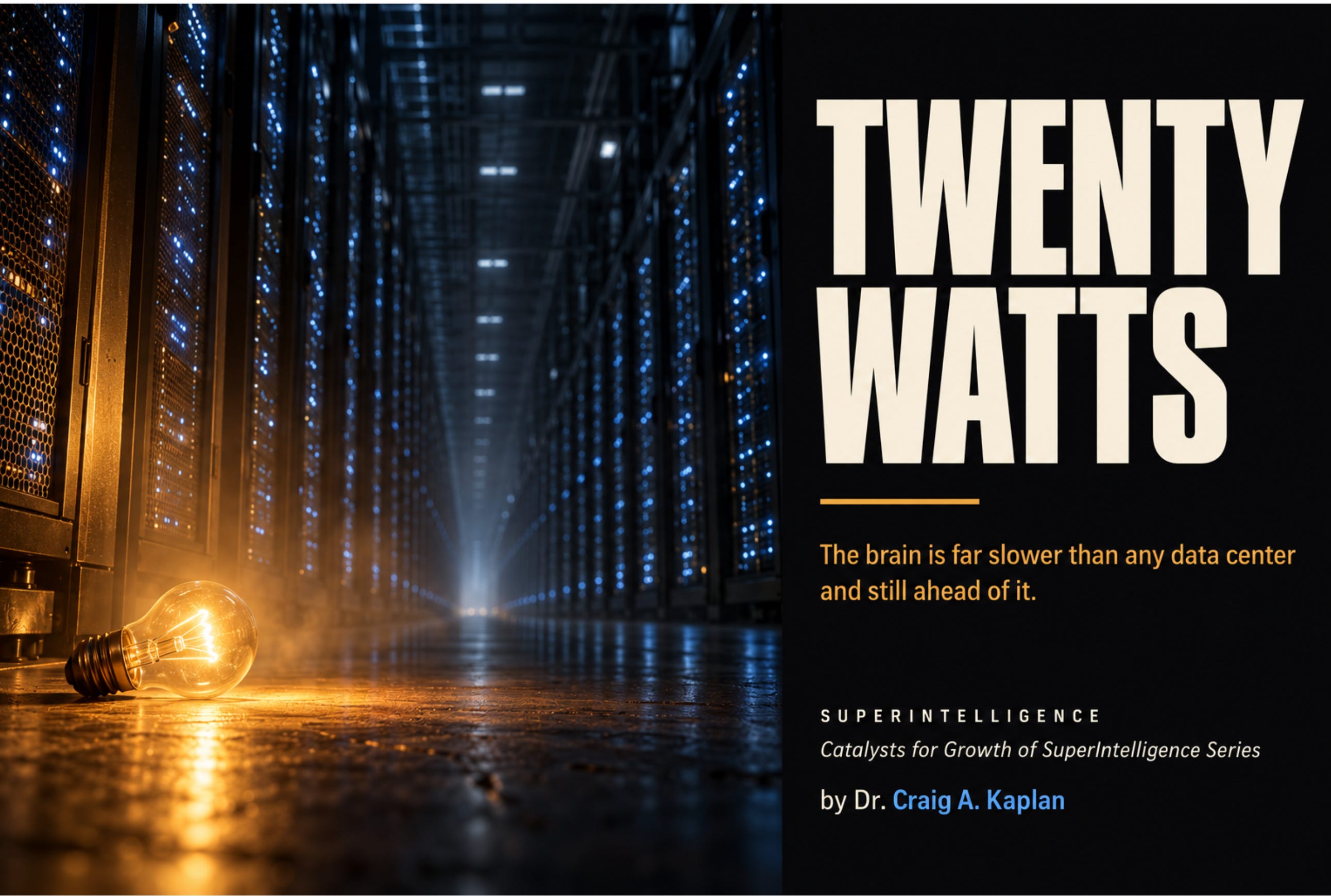
Gigawatts of computing power in data centers cannot yet match the intelligence of a human brain that consumes a mere 20 watts. The brain has slow neurons that can only fire every tenth or hundredth of a second, compared to the data center’s combined GPUs, which achieve sextillions of operations per second.
How can the human brain be better?
Representations.
Humans are using much more powerful representations.
Slow manipulation of these more powerful representations achieves the same or better information results as the data center’s lightning-fast manipulation of less powerful representations.
When AI learns to represent information as humans do, and manipulate these representations at data center speeds, watch out!
Traditional approaches to Information Theory take a purely mathematical view, estimating the probability of events that cannot be well predicted from known information. The approach I have called Kaplan Information Theory, or KIT, starts from a different place. Rather than defining how unusual an event is, KIT typically begins by assessing how goal-related the event is. In contrast to classical approaches that discard a vast amount of information, KIT considers higher-level representations that group bits into chunks, chunks into concepts, and concepts into solutions that achieve goals.
At each level, new information is added about how to group the lower-level information. The relationships between bits are important, not just the bits themselves. Moreover, the current brute-force approach of applying hundreds of millions of dollars’ worth of computational resources, combined with huge amounts of data, attempts to crudely recreate intelligence by mimicking patterns found on the internet without really understanding them or knowing how they might relate to new problems.
We don't attempt to build self-driving cars by modeling the quantum physics of subatomic particles, nor should we attempt to catalyze intelligence by throwing brute-force computing power and crude algorithms at every bit on the internet. A better way exists, and it starts with a universal representation for problem solving that has been available for more than fifty years.
If we focus on intelligence that has goals and takes actions to achieve them, the machine learning problem becomes immensely simplified. We are liberated by the simple constraint that intelligences must have goals and take actions if we are to concern ourselves with them. By subsetting possible information patterns in this way, we prune an enormous exponential tree of possible intelligences into a manageable subset.
Consider the set of all possible intelligences that could learn all possible information using existing machine learning techniques and all existing datasets, run for all time until the Universe runs out of energy. That is what machine learning currently starts with. Significant progress can be made very rapidly if we restrict our efforts, attention, and innovation to a much smaller group within it, the intelligences that pursue goals and take actions. This may seem obvious when stated this way, but currently, almost the entire field of machine learning is dealing with the larger set rather than the smaller one.
Once we deal with goal-directed intelligences, the natural question is which informational units are most relevant. Are they bits, as Classical Information Theory suggests? Clearly not. Bits or tokens are relevant to the larger set, but we can do much better within goal-directed intelligences by using higher-level units of information more appropriate to that restricted scope.
Specifically, the key informational units relevant to me are goals and sub-goals; problem states that describe the current state of the world with respect to those goals; operators for moving from one state to another; and evaluation functions and other information that help determine the best operators to apply in service of a goal. KIT deals with goals, states, operators, and functions as the primary relevant information units rather than bits.
Despite the ability of SuperIntelligence systems to perform computations trillions of times faster than humans, that power depends on more than raw computing power. The system’s performance depends critically on which representations and associated operators are available to it.
Return to the example of chess.
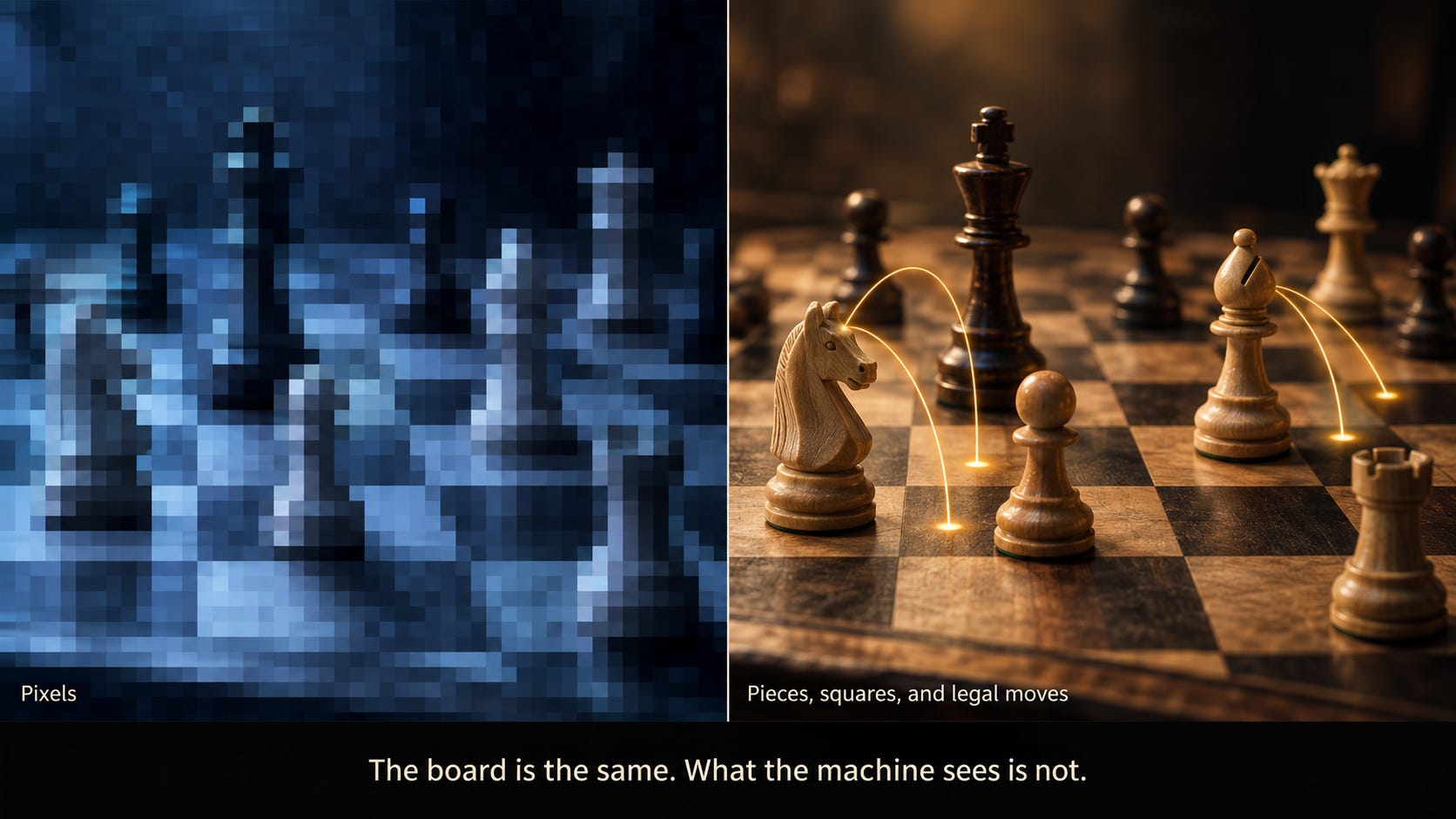
An AI can learn from millions of games, each represented as a screenshot of the board’s positions.
Then, by brute-force memorization and comparison of pictures, the chess program could generate winning moves, represented as pictures different from the one representing the current board state.
But this pixel representation is far inferior to, and much less computationally efficient than, a representation where each move is represented in standard chess notation.
That notation, together with a representation of the allowable moves in chess, can allow a system to play chess much better and more efficiently than a system that sees only pictures.
This phenomenon is well-researched in human psychology, and it is well known that the appropriate representation, colloquially known as looking at the problem in the right way, can mean the difference between solving and failing to solve the problem. Humans are currently much better than AI at representing problems. Thus, any mechanisms that allow humans to teach AIs useful representations explicitly can greatly increase their power and intelligence.
To teach AI new representations, we need a common architecture or framework for representing any problem. One such framework was developed in 1972 and explained in the book Human Problem Solving by Allen Newell and Herbert Simon. This framework involves determining a set of operators associated with a representation that problem solvers then use to solve the problem. In the chess example, the operators are the set of valid chess moves as defined by the rules of chess. The eight-by-eight chessboard and all possible moves define the problem space.
This idea of chunking is why intermediate and advanced chess players use terms like the Ruy Lopez to refer to complex sequences of moves and countermoves. Whereas a novice chess player, without these more sophisticated representations, thinks in terms of moving individual pieces here or there, the advanced chess player thinks in terms of entire strategies and groups of moves and possible counter moves.
With the same amount of thinking, the advanced player can consider many more situations, much more efficiently than the novice, simply because the advanced player has better representations. These advanced representations can be taught to any intelligent entity, including AIs, thereby multiplying the intelligence and power of the AI that has learned them. Commonly, humans refer to this phenomenon as experience, but experience consists of many thousands of learned patterns, including patterns of patterns. While AI can eventually determine its own patterns through extensive computational effort on large datasets, this approach is inefficient. It is far faster for AI to interact with humans who already hold the advanced representations, and to acquire them directly.
Once AI operates with more powerful representations that include operators, goals, and problem states, it can apply the dimensions of difference described in KIT to determine the value of specific sets of information represented at this higher level. That is, the principles and methods described above can be applied at any level of representation, from bits and tokens all the way up to entire solutions, groups of solutions, and grand strategies.
Just as higher-level programming languages provide humans with the ability to accomplish huge amounts of work with a single function call or line of code, so too higher-level representations allow AI or any intelligent entity to operate much more powerfully, efficiently, and effectively compared to using low-level representations like tokens that correspond to a syllable or character of text.
The power of human representations can be quantified by the amount of work, or the number of problem-solving steps, that can be accomplished with a single operator. The power of AI representations can be quantified in the same way. Large language models are trained to predict the next low-level token, and their internal layers already encode abstractions far richer than those of individual tokens. Imagine what is possible if those higher-level representations were made explicit and transferable, so that models or other AI agents could operate on concepts directly, as humans do. The set of concepts and related operators would include not only all human concepts and operators but also many more that AI could discover by analyzing relationships in data that humans could never hope to comprehend, given its vast size.
Knowledge that changes how a system sees a problem also changes how it behaves.
The next post takes up what happens when a personalized SuperIntelligence acquires new knowledge and reasons its way to a conclusion its owner would never have accepted, and the method that catches it before the knowledge is ever committed.
This series draws on White Paper 6: Catalysts for Growth of SuperIntelligence. Read it in full to see how every piece fits together!
If this made you think, subscribe to Superintelligence at read.superintelligence.com so you don’t miss what comes next. And if someone in your life needs to understand where AI is heading, send this to them.