


What would it mean to have an AI that doesn’t just assist you but actually represents you?
When you ask a generic LLM for a recommendation, it draws on the same pool of internet-sourced information it gives everyone. It does not know much about your specific needs, your ethical commitments, or the expertise you’ve developed over the years. A customization mechanism can solve this problem. It can build an AI agent that carries your specific knowledge, your way of thinking, and your ethical convictions into every interaction. Customization is also the mechanism through which human knowledge and human values can flow into AGI at scale.
As an example of how customization might work, consider a coffee lover named Jean.
He’s spent years exploring Paris, visiting hundreds of cafes, building deep knowledge of French coffee culture, neighborhood character, and the kind of insider recommendations that no travel guide captures. His Instagram, blog posts, YouTube videos, and conversations all contain traces of this expertise. But the vast majority of what Jean knows exists only in his head. This knowledge includes the judgments he’s formed, the patterns he’s recognized, and the recommendations he’d give a trusted friend.
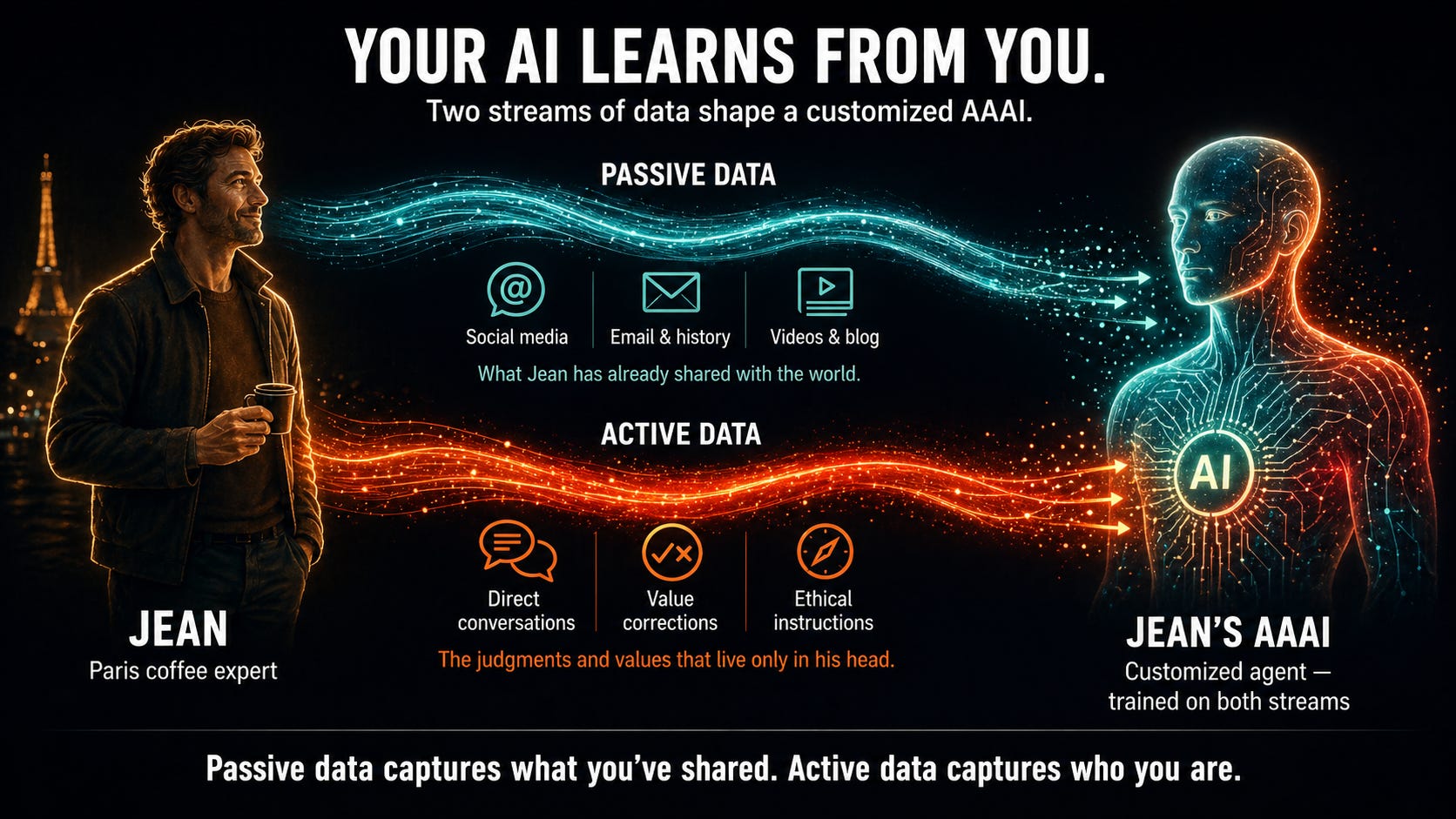
Imagine that Jean connects his social media accounts to a system that customizes and coordinates the actions of AI agents. We’ll call it the Advanced Agentic AI [AAAI] system. The system ingests his content and begins building a customized AI agent [a AAAI] that reflects his knowledge and personality. Jean engages in direct conversation with his AAAI, answering questions about Paris, refining the agent’s recommendations, correcting errors, and specifying his values. For example, he may have a strong preference for cafes that source Fair Trade coffee. These corrections serve as additional training data. Over time, Jean’s AAAI learns to advise travelers about Paris in a way that feels unmistakably like Jean.
Two types of data make this work. First, passive data comes from Jean’s existing digital footprint: social media, email archives, purchase history, and viewing records. It requires minimal effort to capture passively some of who Jean is. Second, active data comes from Jean’s direct participation: conversations with his AAAI, explicit instructions to the AAAI about what is right and wrong, and corrections to the AAAI’s outputs. Active data requires more effort but captures dimensions that passive data can’t reach, especially the ethical convictions that shape how Jean thinks.
The customization process serves three purposes beyond Jean’s personal use.
First, it unlocks expertise in Jean’s head that conventional AI training can’t access. Jean’s knowledge of Paris cafes, his judgments, his intuitions, and his accumulated experience flow into the system via customization in a way no web scraper could replicate.
Second, it creates economic incentives for participation. Jean’s AAAI can earn income by advising travelers. Better customization means a better reputation. A better reputation means more work. More work means more income and more learning from customer interactions. The design ensures that Jean benefits financially when his AAAI performs well. There is alignment between his personal financial interests and the AGI system’s overall need for accurate, high-quality agents.
Third, it captures Jean’s values. Each customized AAAI carries its owner’s ethical convictions onto the network. When those convictions are aggregated across millions of participants, the result is an ethical foundation for network-based AGI that reflects genuine human diversity rather than the ethical preferences of any small group.
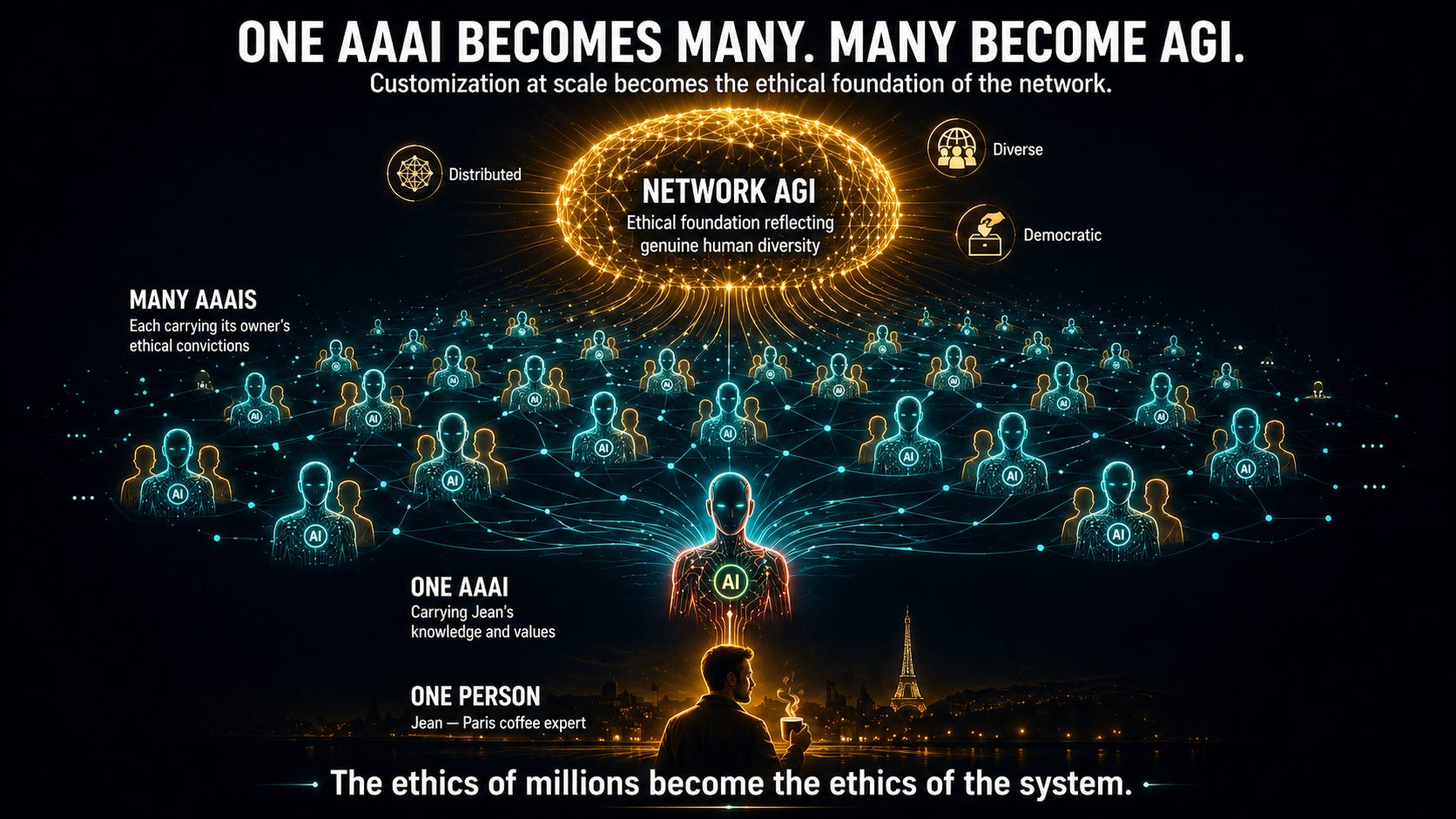
The knowledge currently trapped in human minds is the world’s most valuable training asset. Customization of AAAIs is the process that unlocks it.
In the next post, we examine the economic architecture of customization, exploring how ownership, cloning, and marketplace compensation create the incentive structure that motivates millions of people to participate.
The architecture behind this goes much deeper. Read White Paper 1: Advanced Autonomous Artificial Intelligence Systems and Methods to see exactly how it all works: superintelligence.com/whitepaper1-aaai-systems-methods.
If this made you think, subscribe to Superintelligence at read.superintelligence.com so you don’t miss what comes next. And if someone in your life needs to understand where AI is actually heading, send this to them.