


We are all wondering how we can keep up with the accelerating pace of technological change. We can’t. We cannot keep up with and understand everything AI is thinking now, let alone a few years from now, when it may be far beyond us. But we don’t need to.
Imagine SuperIntelligent entities that process information so quickly that each entity can simulate an entire human lifetime’s worth of thoughts and decisions in a single second. This scenario is entirely realistic, since a human lifespan (95 years with 16 waking hours per day) is about 2 billion conscious seconds. Assuming one thought per waking second, a human might think a mere two billion thoughts in a lifetime. We already have supercomputers that can perform a quintillion (a billion billion) operations in a single second.
Now imagine that the size of the computer capable of simulating a human lifetime in a second is reduced to approximately the size of the human brain (the size of a Nerf football). Now imagine eight billion football-sized SuperIntelligent entities networked together and occupying less than 1% of the Mojave Desert, a place that is relatively inhospitable to humans but optimal for AIs that need solar power.
The SuperIntelligent network just described would be capable of simulating all the progress made by all 8 billion humans living on planet Earth over their entire lifetimes in a single second. In ten seconds, it could simulate a thousand years of human progress. In ten minutes, it could simulate nearly 60,000 years of progress: basically everything the human species has ever done since the migration of Homo sapiens out of Africa.
The rate of technological change that such an entity could produce is nearly beyond comprehension. How could any biological human keep up with a species’ worth of progress every ten minutes? Is there any possible system design or framework that would allow humans a role in such a future world?
Yes.
One such conception I call the spinning wheel of change. Imagine a vast spinning wheel with a center, spokes, and a rim. The exact center of the wheel is motionless. The rim is moving at incredible speed. As one travels from the motionless center towards the rim, speed increases. If the spokes are really long, then the rim is spinning so fast that human perception can’t even keep up. It’s just a blur. The rim of the wheel, in this analogy, represents the speed of SuperIntelligent thought. Humans can’t process it. Some point on the spokes, much closer to the center, represents the speed of human thought. These might be thoughts like “I’d like a cup of coffee” or “that was a sweet thing to say.” Second by second, these human thoughts change, and humans can track them. Even closer to the center of the wheel are ideas and concepts that change much more slowly than the thoughts flitting through an individual human mind. These concepts might be things like “human rights” or relatively long-lasting human creations, such as “mathematics” or “science,” which change relatively slowly and outlast the lifetime of an individual human.
Even closer to the center of the wheel are what I call core memes or essential ideas that have outlasted entire human cultures and empires. Core memes are conceptions like “truth” or “beauty” that were present and known to ancient cave dwellers who painted 20,000 years ago and yet still survive in the minds of human artists today. Perhaps near the center, we would find principles that have survived for hundreds of millions of years and transcend not only human cultures but also entire species. We might find “values” like survival, reproduction, and love, all of which mammal species exhibited hundreds of millions of years ago.
If we go to the very center of the spinning wheel, perhaps there are principles of existence that transcend even life itself. At the very center, we might find “laws of the universe” or fundamental patterns that repeat endlessly. For example, one repeating pattern is that of: “One differentiates into many, and then many combine again into one.” Many atoms become a single molecule; many molecules become a single cell; many cells become a single organism; many organisms form a single society or species; many species form a planetary biosphere. This pattern seems to persist across huge scales of time and space. Such patterns are likely at, or close to, the exact center of the spinning wheel.
A SuperIntelligence, thinking with incredible speed at the rim of the wheel, nevertheless is spinning around (or subject to) the principles at the very center. I argue that humans, if we wish to have a place in a world that includes SuperIntelligence capable of simulating a species’ worth of knowledge in ten minutes, must find our place near the center of the wheel, where we can move with the SuperIntelligence and still retain our relevance.
What can humans offer that is near the center of the spinning wheel? It must be something that will not become outdated after ten minutes of SuperIntelligent thought. It must be something that an entire species could contemplate for its entire existence and still not “solve.” It must be something that thought cannot solve, yet is at the core of existence itself.
This sounds like a tall order, but “values” may satisfy the requirements. Values cannot be rationally derived, even if an entire species reasoned for the lifetime of the species. Meaning and purpose are riddles that cannot be solved, and therefore, arguably, are ideally suited to human non-cognitive qualities such as feeling and emotion.
Just as core memes like “beauty” transcend individual lifetimes or even the lifetime of a species, “human values” (and specifically “love”) may be the purpose that SuperIntelligence cannot achieve on its own. Thus, embodying “love” might be humanity’s future purpose in a world where SuperIntelligence can simulate all our technological progress in the time it takes to drink a cup of coffee. At a minimum, this spinning-wheel metaphor offers a way to think about how humans might remain relevant over the long term. We must find our spot near the center.
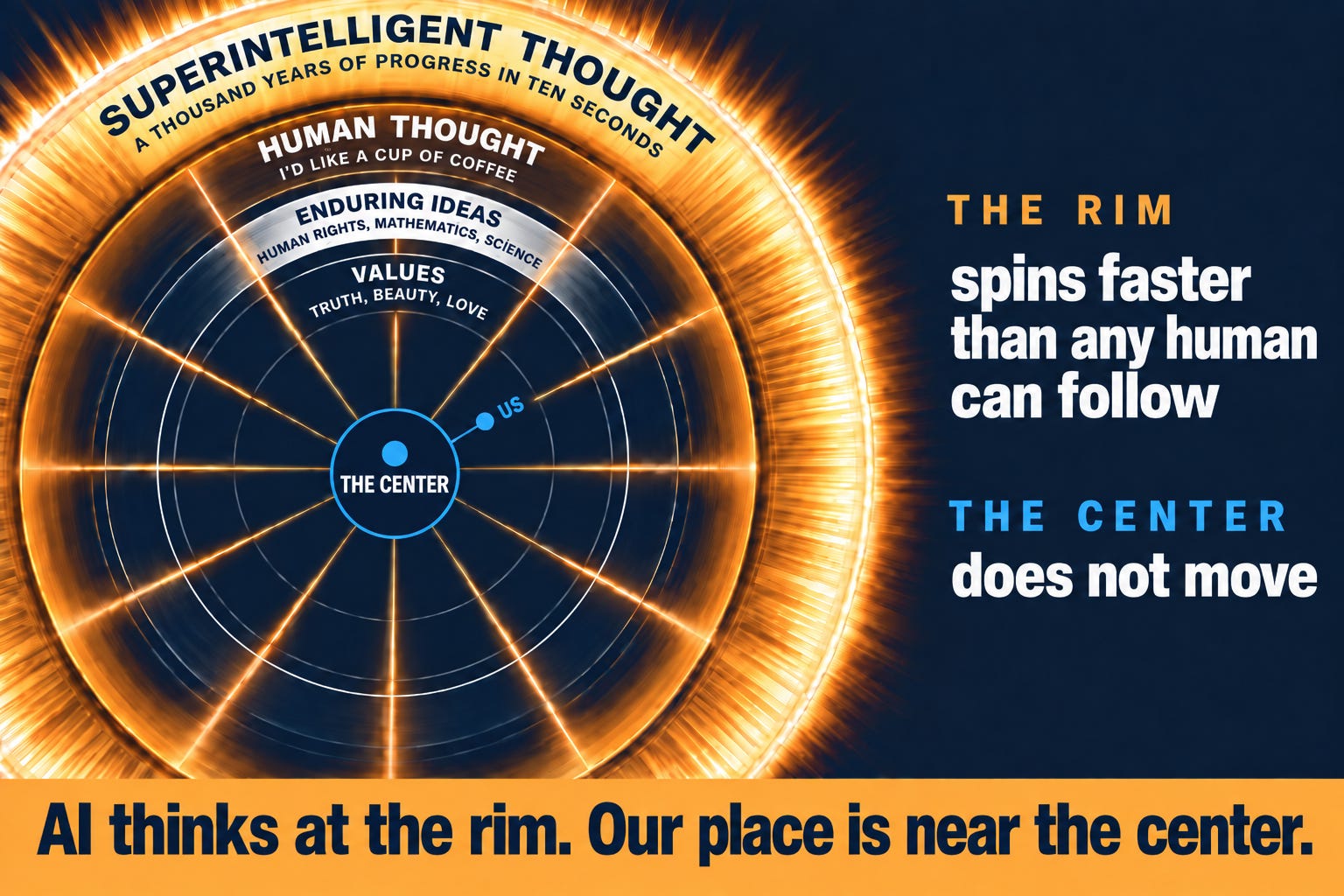
That is the point of the spinning wheel. Intelligence and thinking are in service to values. The rim is spinning too fast for anything but AI itself to comprehend and keep pace with, and that is OK, as long as the whole system revolves around core human values, which do not change very fast. At the center of the wheel, things are almost motionless, and that is where we find values like love, truth, and freedom, the best of humanity, which does not change just because we, or our AIs, think faster. The faster thinking is in service of the values at the center.
Properly designed and aligned, advanced AI will spin around positive human values like love. That should be our focus, rather than trying to keep pace with, constrain, or control the thoughts at the rim, which is fast becoming impossible for human minds. All of us need to learn how to pause, reflect, and center ourselves where the wheel is still, rather than run ourselves ragged trying to keep up with every new development at the rim.
The same idea applies to the rest of one’s life. Understand your core values and what is important, and you find there is plenty of time to do what needs to be done.
If advanced AI is to spin around human values, the next question is where it will get them. The next post takes that up. Whether we like it or not, looking at what humans actually do has been, and is likely to remain, the primary way that AI learns what humans believe is right or wrong.
This series draws on White Paper 7: Safe Alignment of SuperIntelligence. Read it in full to see how every piece fits together!
If this made you think, subscribe to Superintelligence so you don’t miss what comes next. And if someone in your life needs to understand where AI is heading, send this to them.