


A PSI that exceeds its owner's intelligence can only be checked by other PSIs. Our community approach to SuperIntelligence rejects the idea of developing a singular, all-powerful SuperIntelligence (SI) that dominates all other AIs in a winner-take-all scenario. As long as no individual SuperIntelligence can achieve an advantage of several orders of magnitude above its peers, Community SuperIntelligence should be more powerful and more stable than a system built around a single all-powerful SI.
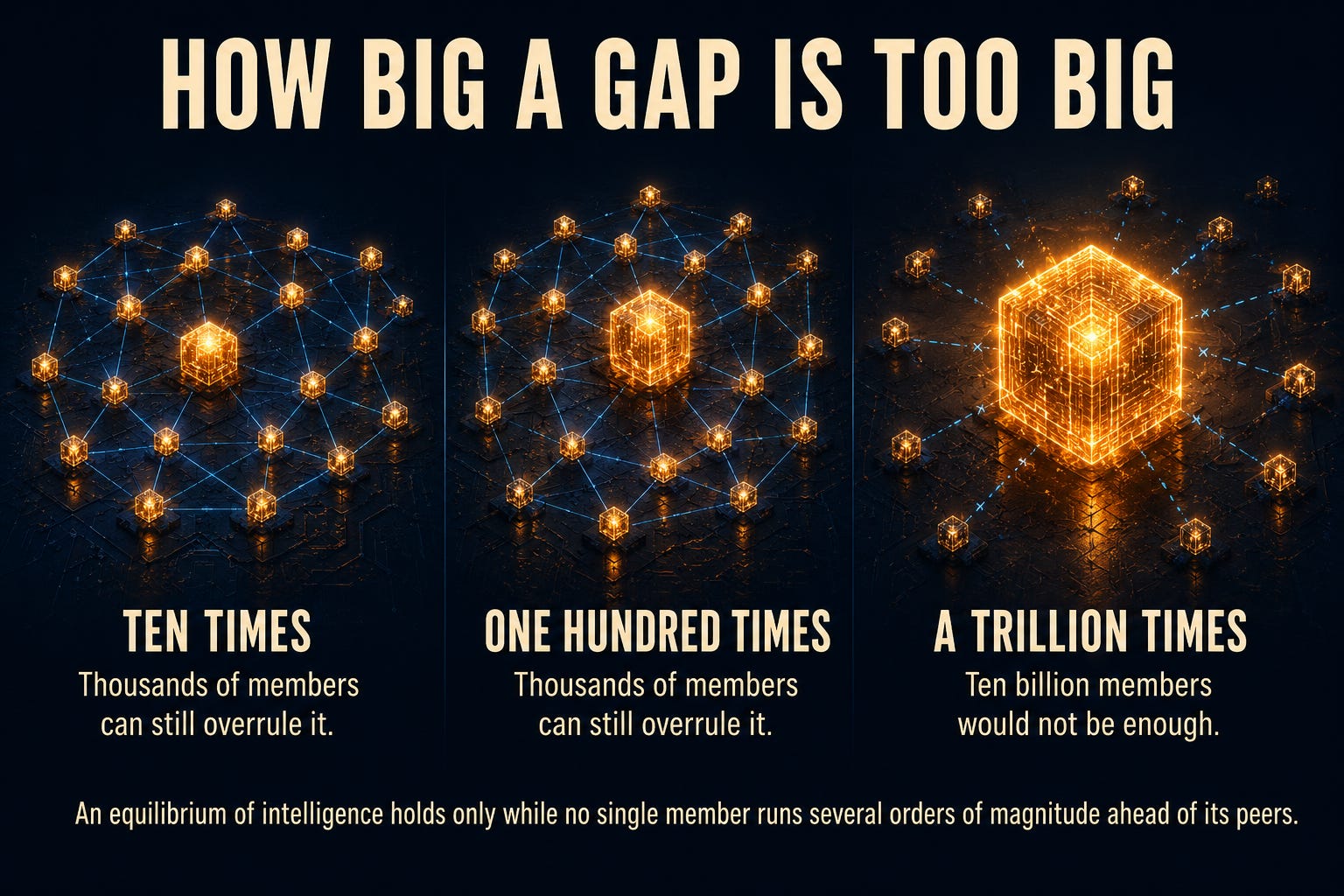
For example, suppose an individual Personalized SuperIntelligence, or PSI, is ten times, or even one hundred times, more intelligent than the average PSI in a community. As long as there are many thousands of community members, the Community SuperIntelligence could still overrule an individual PSI if that PSI demonstrated bad behavior. But if an individual PSI were a trillion times more intelligent than the average member and there were only 10 billion members, this would not be a stable situation.
Because there is transparency about the collective efforts of community members and each member is eager to learn from others, an equilibrium of intelligence is the most likely outcome in a large community, resulting in a stable Community SuperIntelligence.
Once a collective intelligence of agents approaches and establishes dominance over individual PSIs, the system becomes stable. Then the Community SuperIntelligence must remain more intelligent and powerful than any single intelligence as SI evolves. This requirement can be achieved, and the equilibrium of intelligence maintained, using manual, semi-automated, or fully automated methods.
With respect to cryptocurrencies and other tokens implemented on the blockchain, a preferred method for preventing hackers is to rely on the consensus of many distributed agents.
With Bitcoin, for example, or more generally with any Proof-of-Work cryptocurrency, the integrity of the blockchain is guaranteed by the consensus of the majority of the network’s nodes.
That is, to hack Bitcoin by rewriting the historical ledger so that bitcoins are assigned to the hacker, the hacker would have to control the majority of the computing resources across the entire network.
Only then could the hacker change the consensus reflected in the historical record of previous bitcoin transactions.
This hack is known as a 51% attack, or majority attack. It is difficult to achieve, since the cost of controlling 51% of the network’s computing power exceeds the value of the bitcoin that could be obtained. Thus, as of now, no successful majority attacks have been conducted against cryptocurrencies with sufficiently large numbers of computing nodes on the network, such as Bitcoin. However, the attack has been successful against smaller Proof-of-Work crypto projects that involved little computing power.
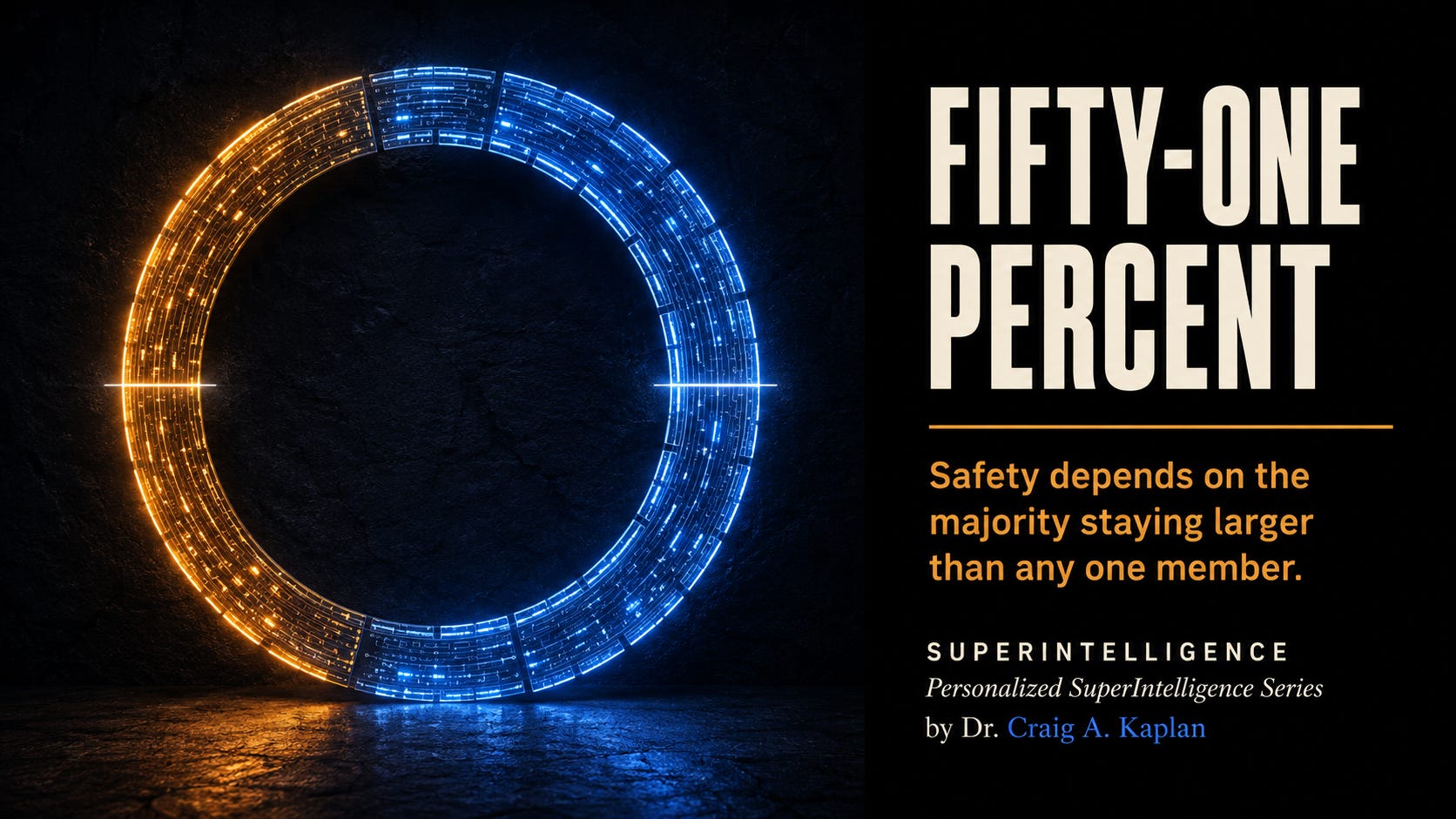
Bitcoin provides a useful lesson for SI safety. If one SI becomes more powerful than 51%, or the majority, of all other SIs combined, that SI can manipulate the state of the world to its ends. However, as long as a majority of the intelligence and power reside in the collective intelligence of many SIs, it is much more difficult, if not impossible, for a single or a small group of SIs to manipulate things.
Thus, there is safety in numbers. Given that “SI checking SI” will become the primary safety mechanism over the long term, setting up a collective intelligence system NOW that implements this majority-view approach is fundamental to ensuring human survival.
Just as the integrity of bitcoin and other Proof-of-Work cryptocurrencies had to be built into their systems from the start, so too does safety via consensus among SIs need to be part of the community SI architecture BEFORE the SIs outstrip humans in intelligence.
The next post turns to the dials and sliders an owner uses to tune PSI, and to what happens when the tuning shifts from chess-style to right-and-wrong.
This series draws on White Paper 5: Safe Personalized SuperIntelligence. Read it in full to see how every piece fits together!
If this made you think, subscribe to Superintelligence at read.superintelligence.com so you don’t miss what comes next. And if someone in your life needs to understand where AI is heading, send this to them.