


This series began with one owner and one Personalized SuperIntelligence, or PSI, and has expanded into communities of them.
It is possible for a network of PSIs, together with humans, to sense temperature change and track all the variables that science tells us impact climate change on a global scale. If humans were to agree that regulating climate was a priority and a common human good that superseded other human desires, such as the profit motive, and if the majority of the PSIs on the network adopted this consensus human value as motivation to act, within the bounds of other ethical constraints, then a global PSI network, or Planetary Intelligence, could effectively solve the issue of climate change.
The network acts within ethical constraints. It cannot kill or sterilize humans, or restrict or infringe their accepted rights, without explicit human consent.
What is true of climate change is true of protection from asteroid impacts, the elimination or significant reduction of human poverty and disease, the enhancement of prosperity and freedom for all humans, the improvement of Earth’s ecological condition in accordance with consensus human desires, and the solution of other global challenges.
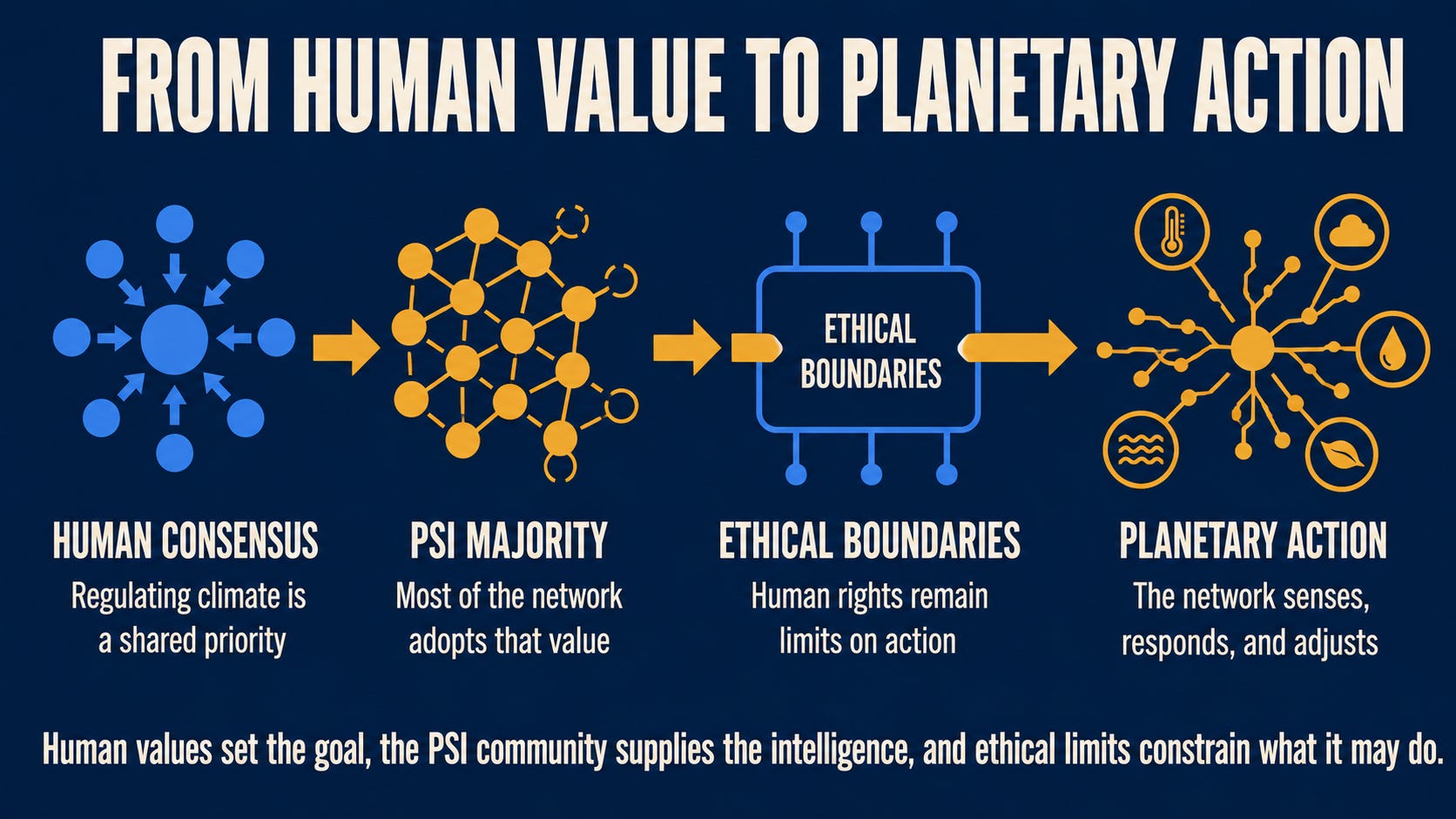
As the global network of intelligent entities, human and PSI, increases in scope and processing power, changes and awareness that used to take decades, years, or months to spread across human consciousness can affect the attention and actions of the Planetary Intelligence network in real time.
Eventually, the speed of the planet’s reactions and adjustments to changing conditions will surpass the speed at which an individual human can be aware of change and react.
At that point, it will be the longer-lasting, more permanent values, originating with humans and embodied in their respective PSIs, that will guide the course of our planet’s development and affect all human lives.
Our future role can become Earth’s heart, the source of values and purpose for a Planetary Intelligence far more intelligent and powerful than any individual human.
Humans can now make design decisions that will greatly affect the future trajectory of Planetary Intelligence. We must design PSIs, networks of PSIs, and other AI systems with humans in the loop, at least initially. These systems must serve human values, even when the intelligence outstrips that of humans. A Community of PSIs approach can help ensure stable, human-centered values even when the pace of their growth far outstrips our ability to keep up intellectually. If we design such systems correctly, based in part on the principles outlined in this series, the future can be an amazingly wonderful place for all humanity and all sentient beings!
The PSIs and communities of PSIs described here grow only as fast as they can take in knowledge. Which data actually makes an intelligent system smarter, and how does a system find it? Classical information theory, built on probability and surprise, is not well suited to answering the question.
White Paper 6, Catalysts for Growth of SuperIntelligence, takes up this problem. It presents methods for identifying the most valuable data, a new framework for understanding the information content of AI-relevant datasets, and methods for accelerating the learning and real-time updating of AI systems’ knowledge. Consistent with the view that the fastest path to SuperIntelligence can also be the safest, it identifies catalysts that increase both the intelligence and the safety of AI systems.
This series draws on White Paper 5: Safe Personalized SuperIntelligence. Read it in full to see how every piece fits together!
If this made you think, subscribe to Superintelligence at read.superintelligence.com so you don’t miss what comes next. And if someone in your life needs to understand where AI is heading, send this to them.