


Picture the major AI labs and the architecture in this series as rivals, and the whole design appears to threaten what those companies have built. That is the wrong picture. Almost every major capability already under development across the AI industry has a place in the design.
Google DeepMind has demonstrated the effectiveness of self-play. Microsoft and OpenAI provide some of the most advanced large language models. Anthropic has done influential work on constitutional methods for AI. NVIDIA builds the chip and software stacks that run it all. Meta, Amazon, Apple, Tesla, TikTok, and Tencent each hold data, platforms, payment systems, or user interfaces that fit naturally into the way an AAAI is customized, deployed, and operated. An AAAI, short for Advanced Autonomous Artificial Intelligence, is the customized AI agent at the center of this series. The architecture is not a competitor to what these companies are building. It is a way of organizing their work into a structure that can produce safer AGI.
Here is how each kind of partner can contribute, grouped by capability.
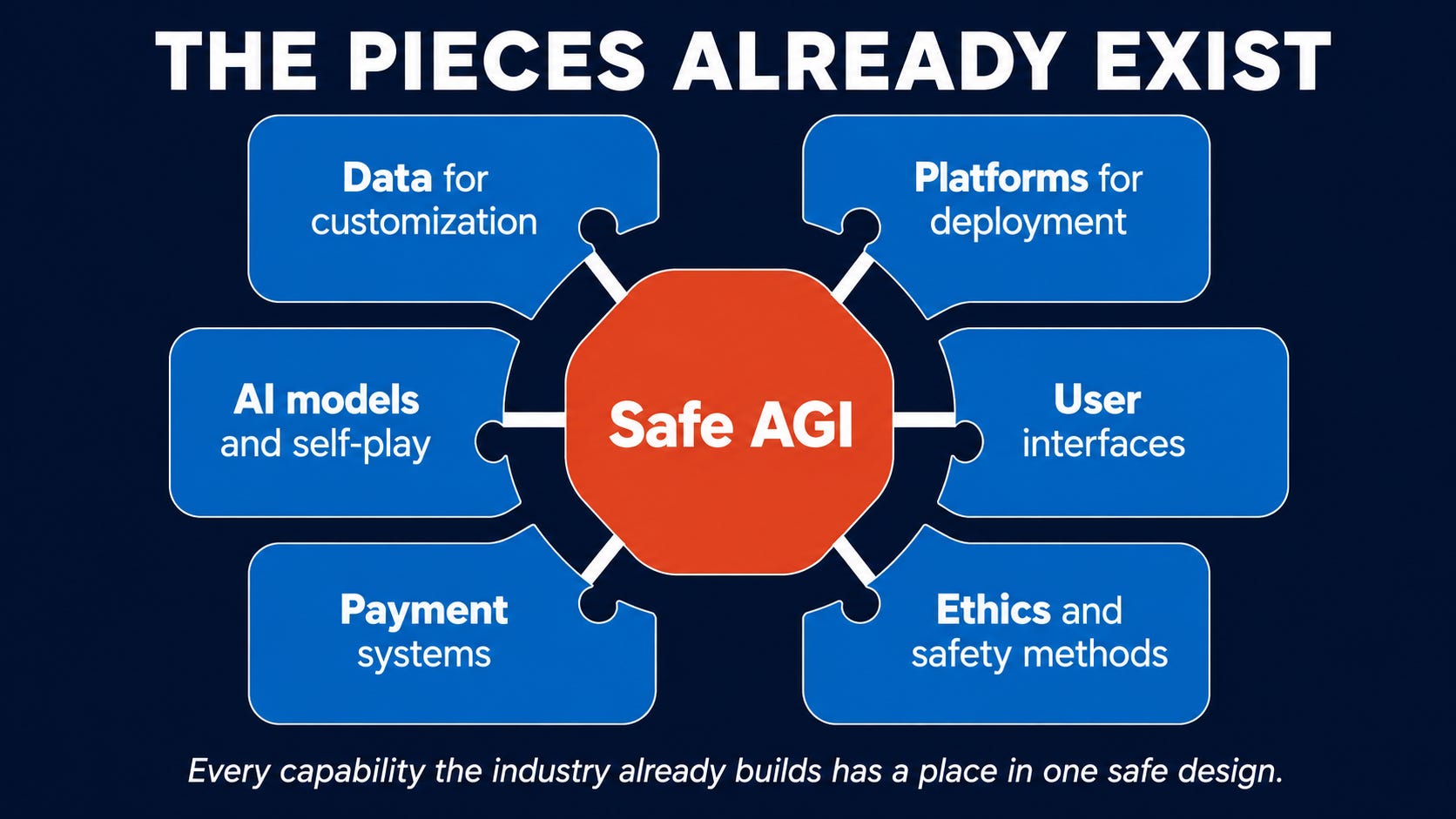
Data sources for customization:
Companies with large user bases can speed up customization.
Meta has ad preferences, social histories, posts, photos, videos, click data, and interest profiles.
Google has search histories, Gmail, Google Docs, YouTube, and Android device data.
Amazon has purchase histories, browsing patterns, and Alexa data.
Apple has data from iPhones, iPads, Apple Watch, and iCloud.
TikTok’s short-form video, transcribed and analyzed, can yield detailed personality and interest profiles, particularly for users with larger online presences.
Tencent’s WeChat and related platforms provide similar data for non-US markets with more than a billion users.
When each user authorizes it, every source contributes dimensions of customization that no single source could supply on its own. The one-click customization mechanism, in which a user grants permission, the system retrieves the authorized data, parses it into training datasets, trains the base AI, and produces a customized AAAI, is what makes this practical at scale.
Platforms for deployment:
Amazon’s Mechanical Turk is an existing marketplace for distributed work.
LinkedIn lets users self-categorize their expertise, which helps match skilled agents to problems, and its social graph helps the matching algorithms recruit problem solvers to specific areas of the WorldThink Tree. Platforms like these can be integrated without having to be rebuilt from scratch.
AI technology:
Google DeepMind has shown the power of self-play learning loops, the same mechanism the AAAI system uses.
Microsoft’s partnership with OpenAI provides access to advanced models.
Anthropic’s models are well-suited to the system, in part because Anthropic’s recent design directions parallel several aspects of this architecture.NVIDIA’s vertically integrated stack, from chip architecture through software libraries to its visual computing platform, offers opportunities to optimize operations at every level. Chips designed to navigate tree structures and apply operators efficiently could enable the most powerful implementations of AGI.
NVIDIA also has an opportunity to build values and ethics checks throughout the entire stack, including ROM on the chips themselves, following the principle that redundant checks at multiple levels can be more effective than a single one.
User interfaces:
Meta’s AI-enabled smart glasses and mobile platforms provide always-on interfaces that allow an AAAI to observe the real world alongside its user.
Apple’s augmented reality devices take a similar approach. Every iPhone, iPad, or new augmented reality device is a chance for AI to accompany users in the world and learn from them.
NVIDIA’s visual computing work, including its leadership in ray tracing and real-time rendering, supports the rich visual representations that can make problem-solving more efficient.
Tesla’s vehicles offer an interface through which an AAAI can learn from driving behavior. Imagine how much more smoothly traffic might flow if every car knew where every other car was going, which exit it planned to take, and how fast it preferred to travel.
Payment systems:
Apple Wallet, Google Pay, Amazon’s payment infrastructure, Tencent’s WePay, and blockchain-based systems can all handle compensation, client payments, and royalty management. Most existing payment systems can be integrated into the architecture.
Ethical and safety contributions:
Anthropic’s work in Constitutional AI can be combined with the approach of aggregating the values and ethics of millions of trained AAAIs to automate supervision. Supervision then rests not on a constitution written by a small group of programmers alone, but on the consensus ethics of many people who trained their own AAAIs. The consensus ethical views of many AAAIs would form the ethical norms of the system. The next post takes that idea up in depth.
An AAAI can move between platforms, and one created on a single site can be cloned and deployed on another. As it travels from marketplace to marketplace, participating companies can choose to share their user data with the user's AAAI in exchange for the user agreeing to share what their AAAI has learned. Data that each company collects is ideally owned by the user and returned to the user in exchange for an economic benefit to the company. Vendors gain additional business from the AAAI's activity, and virtual shopping by AAAIs multiplies their revenue. This is the new economy that can emerge in a world where most intelligence and data have been commoditized. The most advanced systems will always seek the most unique and valuable data to gain an edge, and unique data lives with individual people.
Partner integration speeds up deployment, but the architecture does not depend on it, as the preferred implementation can be built independently. The point that matters is that the design is not at odds with the existing AI industry. It is broadly compatible with it, and it can amplify what these companies already do, opening a safer path to greater intelligence and greater profit for all of them.
The next post returns to the most important of these partner contributions. We will look at how Anthropic’s Constitutional AI can be made representative by basing the constitution on the consensus values of millions of trained AAAIs rather than on the values of a single small group, and why this preserves what is strongest about constitutional methods while addressing their limitations.
This series draws on White Paper 2: Ethical and Safe AGI. Read it in full to see how every piece fits together!
If this made you think, subscribe to Superintelligence at read.superintelligence.com so you don’t miss what comes next. And if someone in your life needs to understand where AI is heading, send this to them.