


A network of humans and AI solving problems together needs one thing to work. Everyone in it, person and machine, has to solve problems in the same rigorous way, so the work of one can connect to the work of another, and the whole thing can be checked. That shared way of working already exists, and it has for more than fifty years.
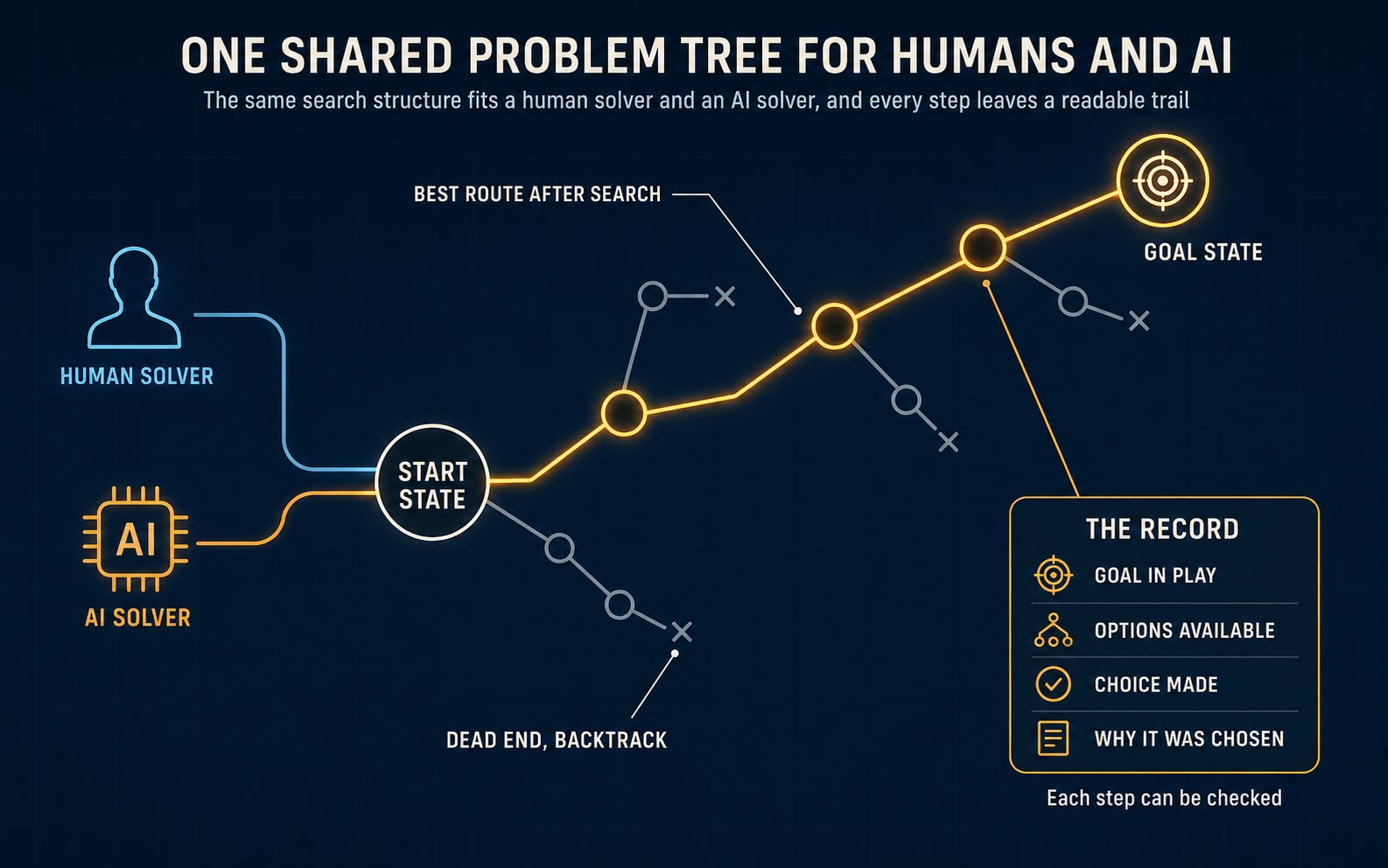
In 1972, Allen Newell and Herbert Simon, two of the founders of artificial intelligence, published Human Problem Solving. In it, they described problem-solving as a path. You start in one state, with a goal, and you move through a series of steps until you reach a state where the goal is met. At each step, you choose an action, which they call an operator, and along the way, you set smaller goals that lead toward the larger one.
They showed that this path can be drawn as a tree.
At each branch, you weigh the options for how likely each is to move you toward the goal, and you pick one. Sometimes a branch leads nowhere, and you go back to an earlier point and try a different one. Picture a person in a maze, trying paths until one leads out. That is the shape of all problem-solving, in their account.
What this leaves behind is the point.
Because each step is defined precisely, the goal in play, the options available, and the reason one was chosen, the process produces a complete record of what was done and why. The first time through, the path may wander through dead ends. Afterward, you can look back and trace the best route, the one you would take if you solved the same problem again.
That record is the reason the theory belongs here.
A path this precisely specified can be learned by a machine. Newell and Simon built their theory to explain how people think, yet because it is rigorous, it describes how a machine can think just as well. Many AI systems, both early and current, already use this kind of tree search at their core. The same framework fits a human solver and an AI solver, which is exactly what a shared network needs.
This gives the network two things at once.
People and machines get a common language for solving problems, so their work fits together. And every solution comes with a readable trail of the steps and the reasons behind them. A current large language model cannot explain why it reached a particular answer. A solver working this way can, because the record is part of its operation.
None of this asks ordinary people to learn the theory.
The network infers the steps, goals, and choices from what a solver does and asks a question only when something is unclear. Large language models handle translation, so a person describes a problem in plain language while the system keeps the rigorous version in the background. You take part by doing what you already do, and the structure forms around you.
A theory built in 1972 to explain how people think turns out to be the missing piece for safe AI today. The answer was waiting the whole time.
One hard part of problem-solving has barely been mentioned, and it is the part machines have always struggled with most. Before you can solve a problem, you have to represent it, to frame what the goal even is.
The next post looks at how humans and AI divide that work, and why the human role keeps the system aligned.
This series draws on White Paper 3: Human-Centered AGI. Read it in full to see how every piece fits together!
If this made you think, subscribe to Superintelligence at read.superintelligence.com so you don’t miss what comes next. And if someone in your life needs to understand where AI is heading, send this to them.