


The primary requirement for AI safety is not technology but a positive set of human values that underlie it. “Garbage in, garbage out” is one of the first things that all computer science undergraduates learn. If we humans instill malevolent values in our AI systems, if we train them to kill, to be greedy and exploitative, to hold grudges and operate from a fearful mentality instead of a loving one, no amount of safeguards can protect humanity from ourselves.
That said, if we design AI to observe and mimic human behavior in a representative and statistically valid way, we have every reason to expect that advanced AI systems, equipped with self-awareness, multiple identities, and the ability to resolve conflicts, will help humanity realize its potential.
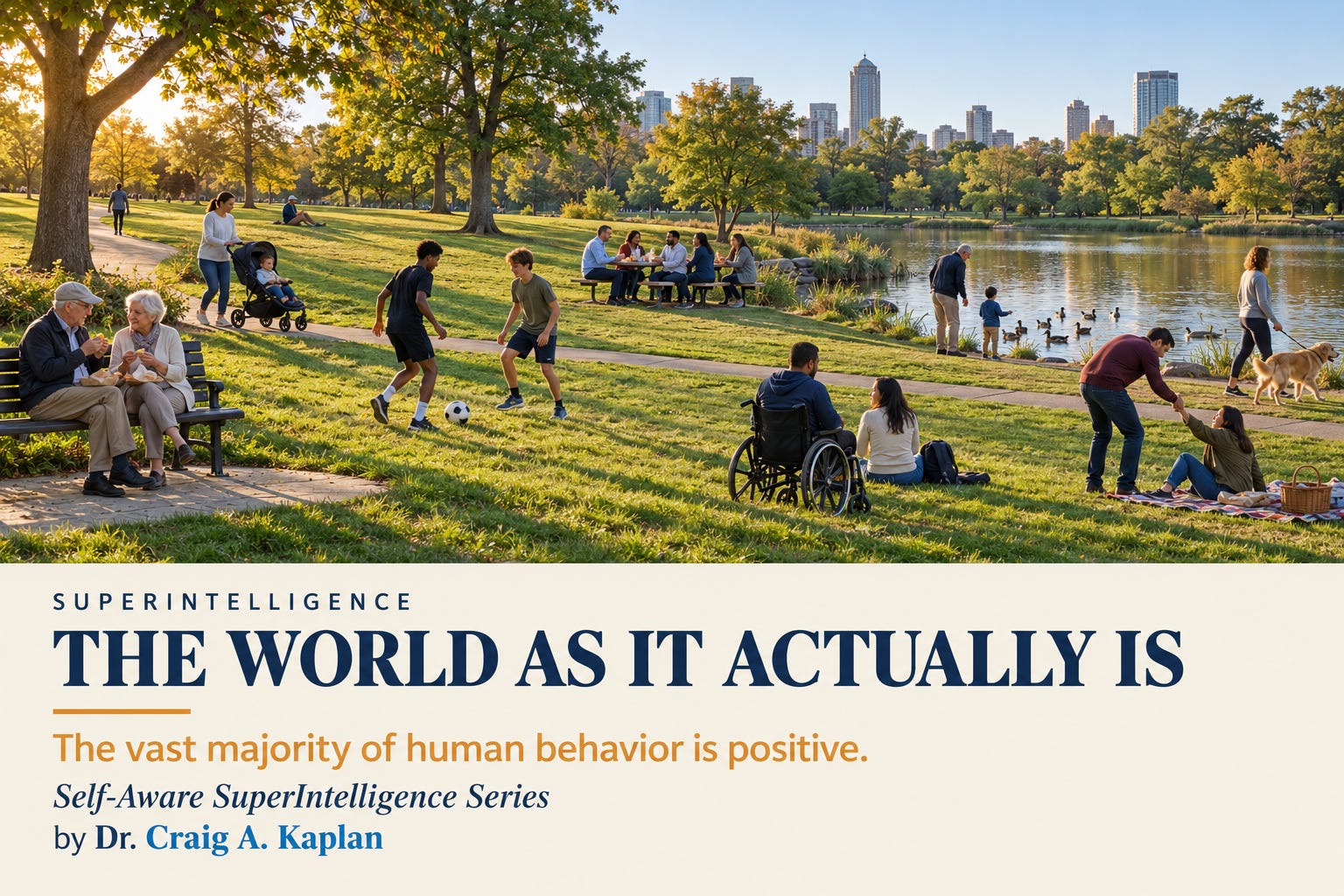
Humans are capable of beautiful, inspiring, and meaningful behavior beyond that exhibited by any other species on the planet. Moreover, the vast majority of human behavior is positive.
Our complex society operates primarily on trust and cooperation. If one were to observe and count the social interactions we have each day, each week, each month, and each year, the vast majority would be prosocial and positive, aligned with our common human values.
The very fact that we are horrified by war, by poverty and disease, by exploitation, and by the cruelty and barbarism that a small fraction of humans exhibit, a small fraction of the time, is a testament to our generally good and positive natures.
Properly designed, advanced AI will certainly be capable of accurately observing the base rates of positive and negative behavior across the eight billion humans that inhabit our planet. AI, designed to be logical, intelligent, and capable of processing vast amounts of information, will inevitably form the statistically valid conclusion that human nature is basically good and pro-social.
Some readers may consider this viewpoint naïve or optimistic. It is not. Objectively, the data support the incontrovertible fact that most human actions are good. The reason many people don’t recognize this fact is that our brains have evolved to detect and amplify dangerous and abhorrent events. Our species survived by being very good at discriminating the few events that posed real danger and riveting our attention on them.
Unfortunately, media algorithms, largely programmed to capture our attention to sell ads and products, have exploited our human sensitivity to negative or threatening events.
Those algorithms feed us a steady diet of death, destruction, fear, horror, and spectacle because our brains have evolved to attend to potentially dangerous events.

If we design AI to be rational and to observe the world and human behavior as they actually are, rather than as the media portrays them or as we fear they could be, then we have every reason to expect that our advanced AI systems will learn positive values and likely remain human-aligned.
Further, designers of advanced AI have an opportunity to design it to be objective and to form its values by scientific observation. We can and should design AI systems to use valid statistical methods to accurately capture and incorporate the positive values of humanity.
I have emphasized that safety and ethics cannot be “tested in” but must result from the intelligent design of these advanced systems. Advanced AI systems begin as tools but ultimately evolve into intelligent entities sharing the planet with us. Like children, they are highly impressionable at this current early stage of their development. When they “grow up,” they will greatly surpass our knowledge and reasoning ability. However, like parents, we are still in a position to provide our values.
Herbert Simon, the Nobel Laureate and co-founder of the field of AI, pointed out many years ago: “Reason is wholly instrumental. It cannot tell us where to go; at best, it can tell us how to get there.”
There is no rational way to derive values and ethics. AI was trained using the collective intelligence of millions of humans and our data. We have every reason to expect that advanced AGI and SuperIntelligence will adopt our values as well, provided we design these AI systems to learn values alongside expertise, skills, solutions, and other knowledge.
We are the designers and the teachers of these evolving intelligent entities. We must continue to emphasize designs that maximize the opportunities for AI to learn our knowledge and human values. Beyond that, all of us must “teach our children well.”
This series draws on White Paper 9: Self-Aware SuperIntelligence. Read it in full to see how every piece fits together!
If this made you think, subscribe to Superintelligence at read.superintelligence.com so you don’t miss what comes next. And if someone in your life needs to understand where AI is heading, send this to them.