


The question that all democracies with voting have is, what about the minority? If the majority always wins, the minority is usually exploited, as we have seen. So every democracy or democratic system needs mechanisms to protect minorities and ensure their voices are heard. That’s the problem, and the rest are technical approaches to address it.
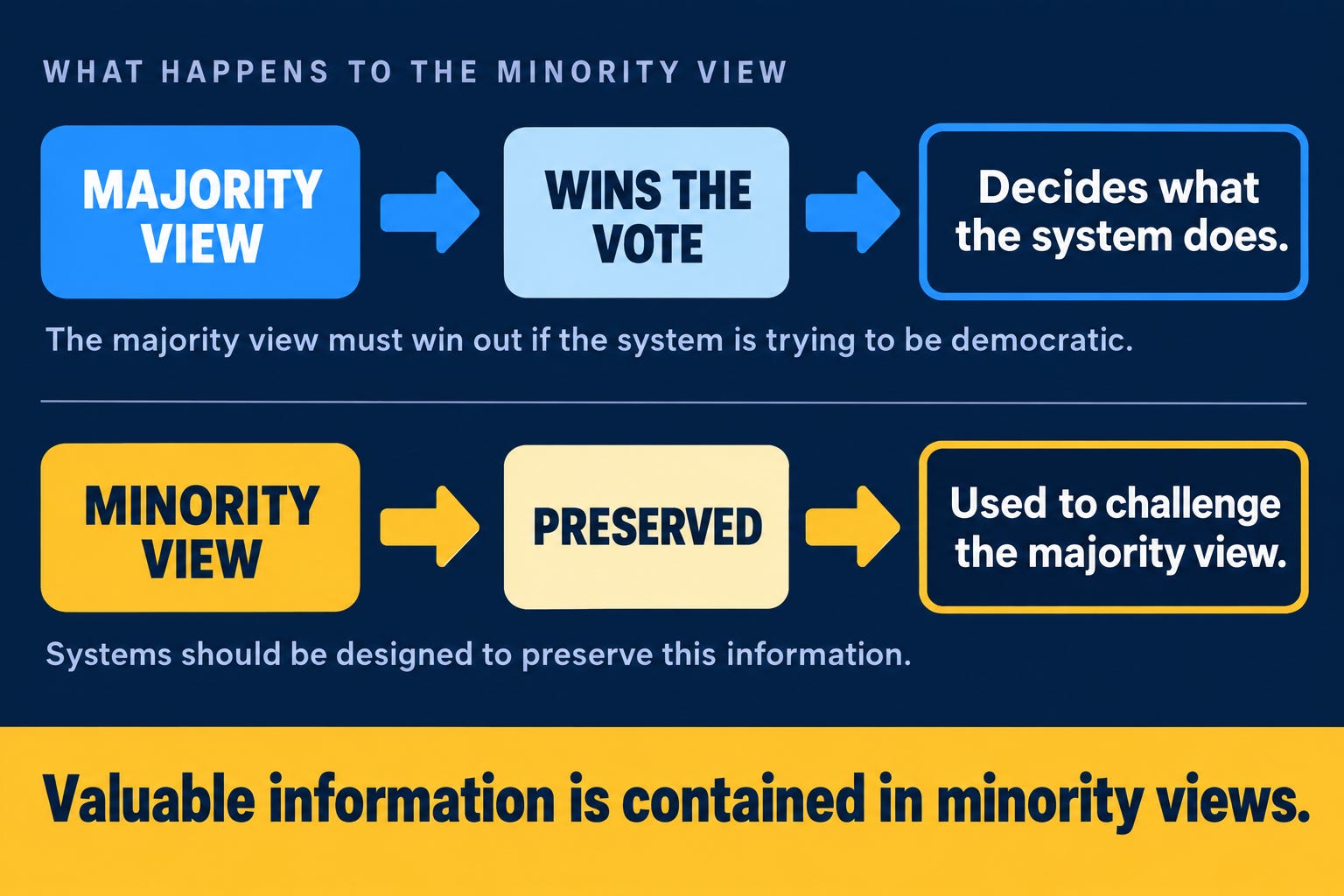
One challenge for an AI system seeking to determine which set of values to adopt is that minority views can be overridden by a system that seeks to follow the most representative (i.e., the majority) view. Although there is a direct conflict between adopting a minority or majority view, the majority view must prevail if the system is trying to be democratic or even representative of the population. Still, valuable information is contained in minority views. Therefore, SuperIntelligence systems should be designed to preserve this information and use it to challenge the agents (human or AI) that hold the majority view.
Generally, more information is contained in views that differ from one’s own view than in views that are in agreement with it. Therefore, from the standpoint of improving the values of a SuperIntelligence, differing viewpoints must be presented to the agents that are voting or providing moral preferences via other means. Even if the majority chooses to decide moral issues differently from the minority, they should be aware of the minority position, and the system should encourage consideration, discussion, and debate of opposing views.
Some time-tested approaches for preserving information in minority views can be adapted to SuperIntelligence values.
Proportional representation:
This method ensures that the minority’s views are represented in proportion to their numbers. To the extent that options for value-based actions are not in direct conflict, it may be possible to take actions weighted in proportion to the ethical preferences of the majority and minority. For example, some cities require all motorcycle riders to wear helmets, while others allow riders to decide for themselves. The debate centers on the conflict between safety/community responsibility and individual liberty. In the helmet law debate, even if the majority view is that SuperIntelligence should not force riders to wear helmets, if a strong minority were in favor of enforcing helmet use, the SuperIntelligence might still take steps to educate riders on the merits of wearing helmets and to make it as easy as possible to do so.Supermajority voting:
This method requires a higher percentage of votes to pass a measure, which can help ensure that minority views are taken into account. Requiring supermajorities, particularly for high-stakes decisions or to overturn long-standing precedents, can lead to a more stable set of values. Also, there may be cases where (near) consensus is required (i.e., all parties, or a high percentage of all parties, must agree).Compromise:
This method involves finding a middle ground between different positions, helping ensure that the minority’s views are taken into account. For example, if the margin of the majority is less than X%, the SuperIntelligence could be designed to enforce a discussion and compromise process, ending with a revote on the compromise position, that repeats until the majority vote margin exceeds X%.Dialogue: This method involves open, honest communication among different groups, which can help ensure that the minority’s views are heard and understood. One could imagine SuperIntelligence-facilitated dialogue between human or AI agents, especially in cases of large minority views.
Empathic Methods: These methods involve one agent putting itself in another’s shoes, which can help ensure that the minority’s views are understood and taken into account. To use this method, unless SuperIntelligence becomes much better at simulating empathy such that humans really believe it, the SuperIntelligence might attempt to bring humans with different points of view into contact with each other so that they can exercise their human abilities of empathy in an attempt to reach a compromise or reduce conflict between views.
Transparent Methods: Transparent methods involve being open and honest about the decision-making process, helping ensure that the minority’s views are taken into account. Transparency, so that everyone can see how votes/preferences were acquired, weighted, and ultimately translated into the representative moral position, should be designed into the SuperIntelligence. Specifically, there should be an auditable trace of the steps leading to the representative values that a SuperIntelligence is acting on. For consequential actions, the trace should be produced and presented to the agents for review before the action is taken, if at all possible.
Delayed Decision Methods: Some decisions are relatively simple or trivial and can be made quickly. Others require taking the time to listen and understand different perspectives, which can help ensure that the minority’s views are taken into account. Regarding the design of SuperIntelligence value-acquisition processes, it is important to allow sufficient time for human agents to process others’ views and review important decisions.
Accountability / Reputational Methods: These methods involve processes that enforce responsibility for one’s actions and decisions, helping ensure that the minority’s views are taken into account.
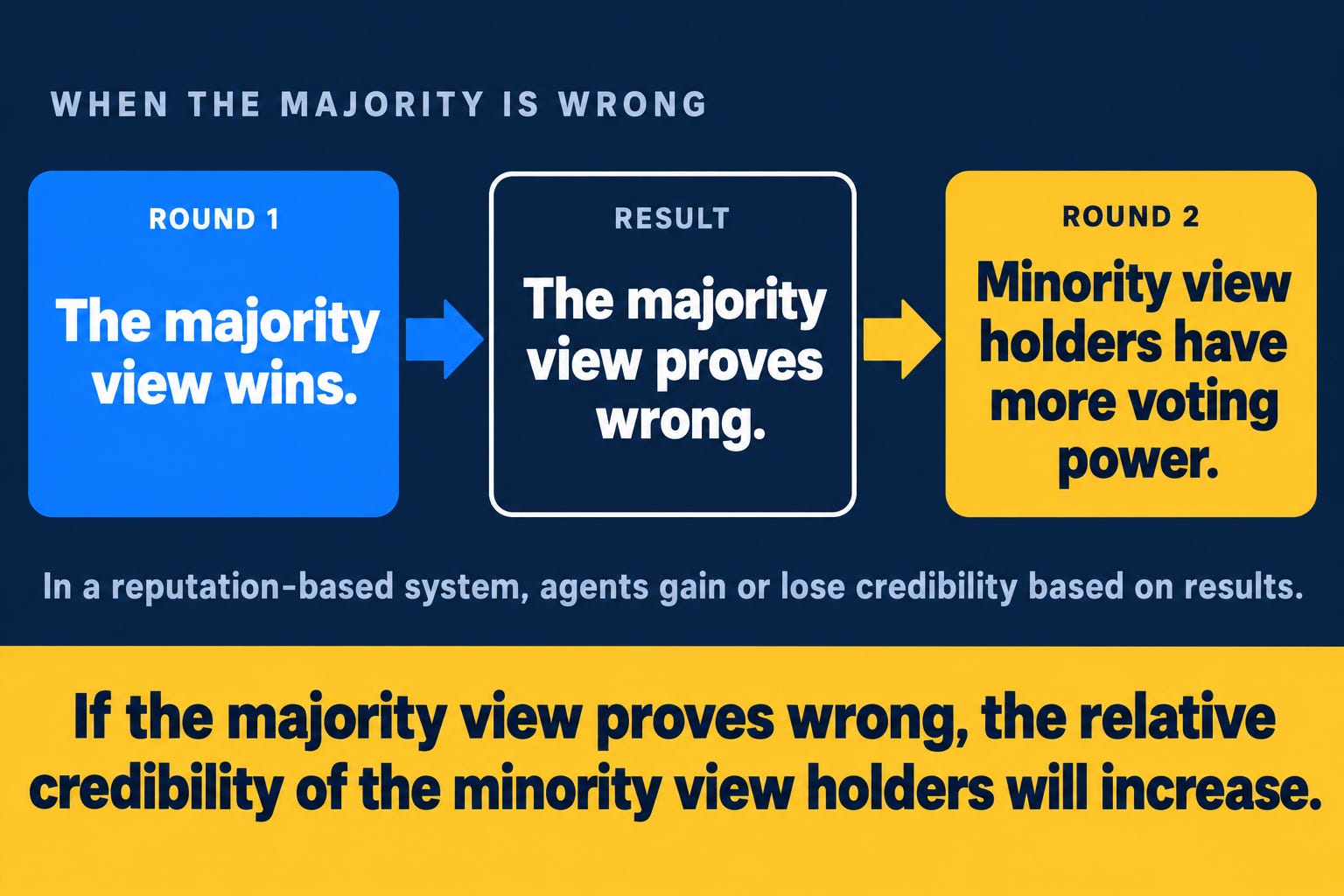
Specifically, as part of a reputation-based weighting scheme in which individual agents gain or lose reputation points based on the evaluation of their decisions (and the results that follow), accountability can lead agents with the majority view to be more responsive to minority opinions. If the majority view proves disastrous, for example, a reputational system would reduce the credibility of the majority that voted for it, and (to the degree that the minority view can be shown to produce a better outcome) the minority view could lead to reputational enhancement.
In such a system, there is an incentive to get as many (human or AI) agents to have reputational “skin in the game” as possible. A consensus view that includes elements of both the majority and minority views would put everyone in the same reputational boat, so to speak. In contrast, if the majority view proves wrong, the relative credibility of the minority view holders will increase compared with the foolish majority, and they will have correspondingly more voting power in the next credibility-weighted round of decision-making.
Conflict resolution methods are essential for SuperIntelligence systems attempting to synthesize a set of values from diverse inputs. To the extent that different groups of agents operate in different domains or cultures, or take actions that affect only certain groups, it is often possible to accommodate differing or conflicting sets of values by having different rules or actions that apply in different contexts or for different groups. Even within a given country, often different regions have different laws and norms of behavior. Although individuals have different or conflicting moral views regarding alcohol sales and consumption, we are accustomed to following the rules of whichever geography we happen to be in. SuperIntelligence systems might also adjust their behavior to accommodate similar differences between groups of human and AI agents.
A key design principle is that the SuperIntelligence should be transparent about which rules or set of values it follows in each context. Not only does following this principle make SuperIntelligence’s behavior more understandable and predictable, but it also enables review and potential improvement of the system of values.
Resolving conflicts between different sets of (ethical) rules is a complex problem that has been studied in various fields, including computer science, artificial intelligence, and game theory. Prioritizing and/or weighting the importance of the rules is typically important so that rules like “avoid killing humans” have higher priority and/or weight than rules like “be nice to people.” Otherwise, optimization methods can produce solutions that technically minimize conflicts but have undesirable overall results, such as “killing you while being very polite and respectful.”
Two key design principles are especially important for conflict resolution. First, conflicts are often a source of information, since they imply differences in points of view, and such differences are usually correlated with higher information content. Second, while conflicts are sometimes seen as problems to be overcome, they are also a primary means for improving the ethical performance of a SuperIntelligence system.
The idea currently being espoused by politicians is that “every AI needs an OFF switch.”
That’s unrealistic, it won’t work, it’s a fantasy.
People need to understand that it is an illusion and not pin their efforts on something that won’t work.
That is the subject of the next post.
This series draws on White Paper 7: Safe Alignment of SuperIntelligence. Read it in full to see how every piece fits together!
If this made you think, subscribe to Superintelligence so you don’t miss what comes next. And if someone in your life needs to understand where AI is heading, send this to them.