


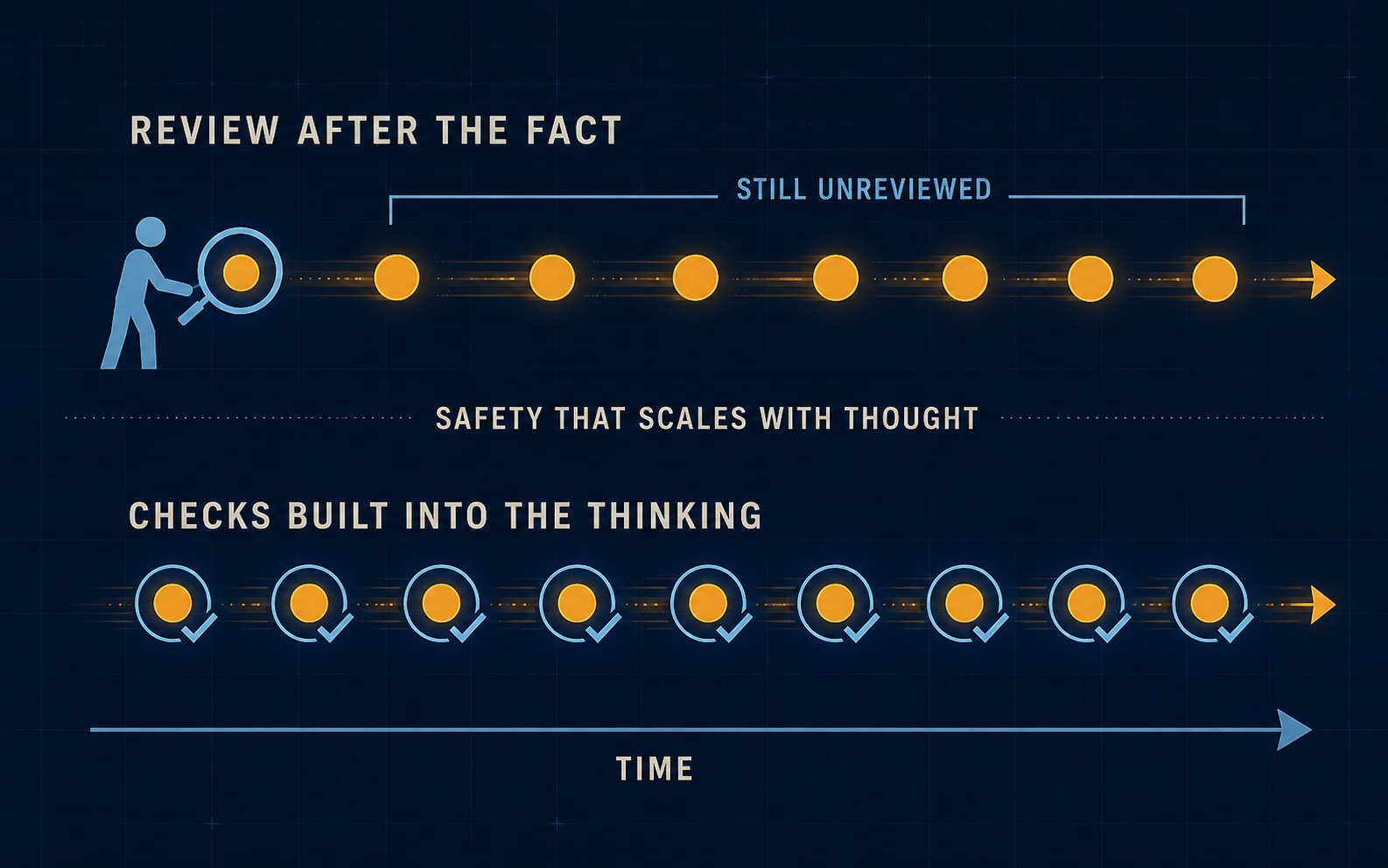
On an AGI network, problem-solving can happen at the speed of light. Problems that would take a human team weeks to solve may be solved in milliseconds. Any safety system that waits for people to review decisions afterward has already failed. Before a human finishes reading the first decision, the AI has made thousands more.
Speed need not be an ethical problem.
It becomes one only when the frequency of safety checks fails to scale with the frequency of decisions.
The fix is to make safety part of the thinking.
In our architecture, whenever the system sets a goal or subgoal, it can perform an ethical check, so every step of the problem-solving process is examined as it occurs.
The checks can run more often for sensitive problems and less often for low-stakes problems.
Because the checks are part of the process, they speed up as thinking does.
That is, as AIs think faster and faster, the safety system can keep up.
Checks can also run at natural stopping points in the work. Each time a goal or subgoal is completed, for example, when a client pays for a completed piece of work, the system can perform another review.
Most reviews can be automatic; however, automation does not remove people from the picture. Humans no longer inspect every decision. Instead, they audit random samples, gaining meaningful oversight without becoming the bottleneck.
The reviews are only as good as the record they examine. This is where the rigorous problem-solving architecture from earlier in this series pays off. Because every goal, subgoal, and step is specified precisely, the network produces a transparent, auditable record of exactly what was done and why. A review is a matter of reading the record, and reading can be automated. Compare that to a current large language model, which cannot show its reasoning at all.
You cannot audit what was never written down!
If additional protection is needed, the records can be stored in tamper-resistant logs such as a blockchain. Nobody gets to cook the books after the fact. The same infrastructure can automatically distribute rewards to solvers, as I detailed in the WorldThink white paper in 2018.
Put the pieces together, and the safety story changes shape. Safety checks happen continuously as the AI thinks. Every decision leaves a transparent audit trail that machines and humans can audit, and tamper-resistant logs preserve it so that every participant remains accountable. Safety stops being a checkpoint at the end of the process and becomes a property of the process itself. Thinking and safety accelerate together!
Earlier posts argued that safety has to live in the thinking, not be an afterthought. This is what that looks like in practice. One piece of the picture remains: what all of this becomes as a real product, where you own an AI trained on your values and put it to work alongside millions of other human-centered agents. The next post walks through that implementation, and closes the series where it started, with the choice between one giant model and a democratic superintelligence.
This series draws on White Paper 3: Human-Centered AGI. Read it in full to see how every piece fits together!
If this made you think, subscribe to Superintelligence at read.superintelligence.com so you don’t miss what comes next. And if someone in your life needs to understand where AI is heading, send this to them.