


At my last company, PredictWallStreet*, the combined predictions of millions of ordinary retail investors performed as well as the best hedge funds, and often better. These were not professionals. They were everyday people, and aggregated by a simple system, their judgment beat the most highly paid minds on Wall Street, people who spend every waking hour trying to gain an edge in the markets. Two heads are better than one. Two million coordinated heads beat the experts.
If a crowd can do that, then the thing we call general intelligence may not have to come from one giant model at all. It can come from many.
That result points to a question worth sitting with. How do you build a network that can solve any problem, or do any intellectual task, as well as the average human, or better?
One answer is a network of human problem solvers joined by a shared, rigorous way of working together.
A problem comes in.
One or more people work on it and return a solution.
Because the network contains humans, it can solve anything an average human can.
Because it contains many humans whose efforts are coordinated, it often does better than any one of them.
PredictWallStreet was a working version of this, where ordinary people together outperformed the professionals at one of the hardest problems there is.
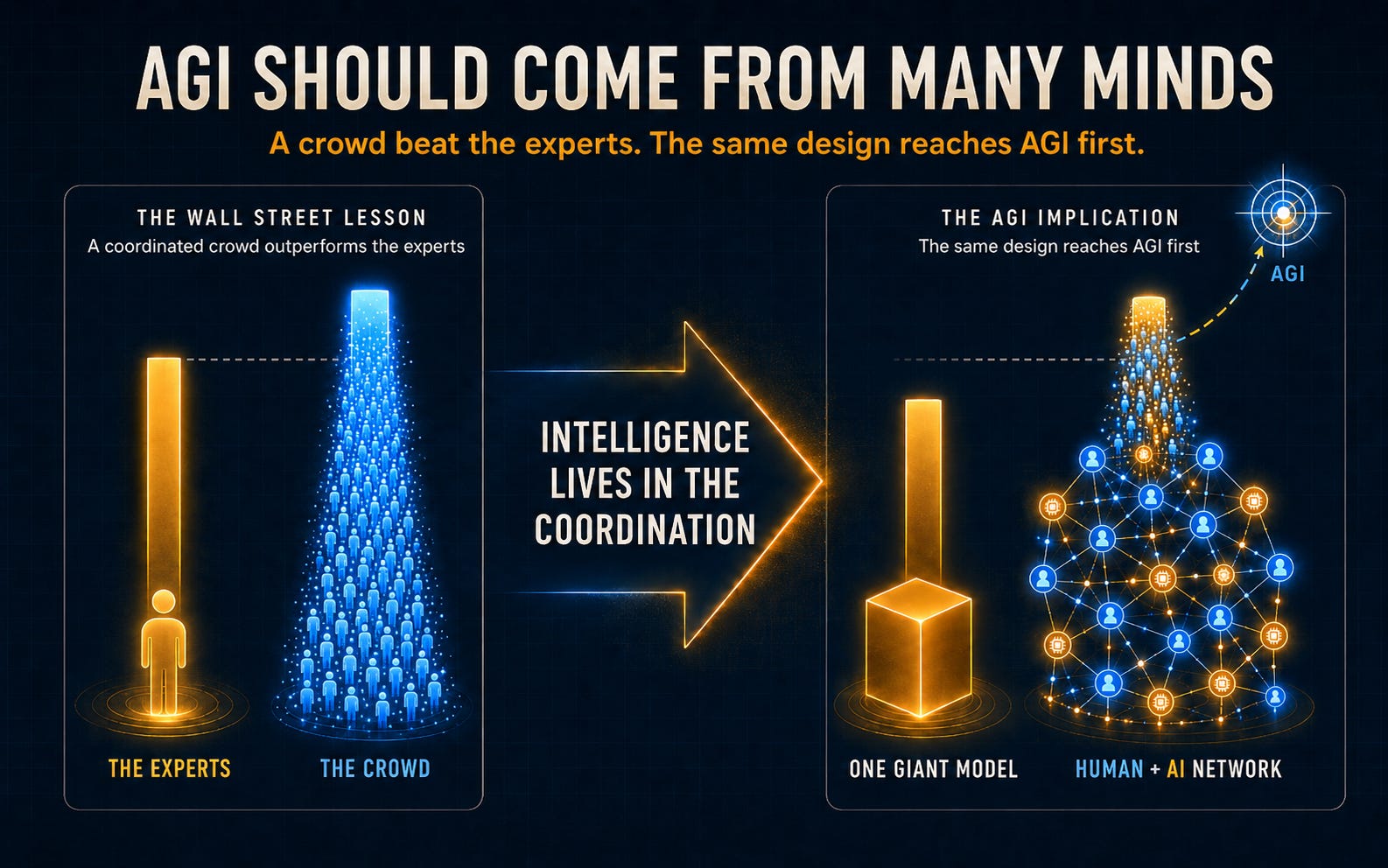
No single member of that network was a market genius. The intelligence lived in the coordination, not in any one head. This is the idea that breaks the Uber-LLM assumption. General intelligence does not have to reside in a single mind. It can be a property of a network in which each member is narrow, and the system as a whole is broad.
An objection comes up fast.
The whole appeal of AGI is that machines think and scale far faster than people. A network of humans has to communicate and coordinate, which is slow. Would it not scale poorly? Is that not exactly why the field wants one enormous model to be the AGI?
The answer is that not all solvers need to be human.
Capable AI models already exist and can join the network as solvers alongside people. Picture a hybrid network, millions of human and AI solvers working the same problems under the same rules. Humans supply judgment and values. The AI supplies speed and scale. The network stays general because people are in it, and it grows fast because machines are in it too.
The approach can be the fastest path to AGI.
It does not wait for a single model to somehow become generally intelligent on its own. It assembles general intelligence now from the people and AI models that already exist, and it gets faster every time a more capable model plugs in.
The crowd that beat Wall Street was not made of geniuses. It was made of ordinary people, coordinated. AGI can be built the same way.
One requirement makes the whole thing work. Humans and machines need a shared, rigorous language for solving problems, because a machine takes instructions literally and a loose specification invites error.
The next post takes up that language, a theory of how people solve problems that turns out to fit machines just as well.
*Sold in 2020
This series draws on White Paper 3: Human-Centered AGI. Read it in full to see how every piece fits together!
If this made you think, subscribe to Superintelligence at read.superintelligence.com so you don’t miss what comes next. And if someone in your life needs to understand where AI is heading, send this to them.